












A Break Every 30 Minutes: Why Your Childs Eyes Need Rest From the Screen


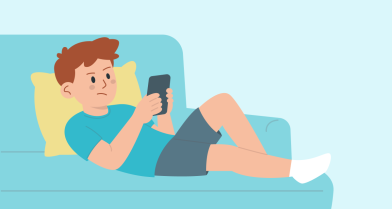
When your child is glued to a screen, they blink about three times less than usual — roughly 4-5 times a minute instead of 15. Their eyes are literally drying out in real time, but they don’t feel it because they’re absorbed in a game or a video. The result: redness, itching, and over time, potential vision problems.
Most parents already know that serious talks about screen harm, science lectures, and outright bans don’t really work. What does work is gentle, regular reminders to stop and rest — the kind that gradually train the brain to make it a habit.
What’s happening inside the eye
When a child looks at a screen, a tiny muscle inside the eye — the ciliary muscle — tightens. It squeezes the lens to keep the close-up image sharp. For as long as your child is watching a cartoon or beating a game level, that muscle doesn’t relax for a second. Imagine holding a bag of groceries at arm’s length for thirty minutes straight. That’s roughly what it’s doing.
Ophthalmologists call this “digital eye strain”, and the statistics isn’t great: during the pandemic, when children shifted to daily online learning, the prevalence of this condition among kids rose to 50-60%.
Screen time and the bigger picture: myopia
A major 2025 analysis found that one in three children worldwide is already nearsighted. Over the past 30 years, the share of nearsighted kids has climbed from 24% to 36%. If current trends hold, by 2050 there will be more than 740 million nearsighted children and adolescents.
The risk of myopia rises sharply once screen time exceeds one hour a day — and it keeps climbing with every additional hour.
The earlier myopia sets in, the faster it progresses, bringing an increased risk of retinal detachment, glaucoma, and early cataracts — things no one wants to think about when their child is seven.
The power of a pause
When a child looks away from the screen and focuses on something in the distance, several important things happen at once.
The muscle relaxes. The lens releases its grip on the near focus, and the entire visual system gets a breather. It’s like finally setting that bag of groceries down on the table.
Blinking returns to normal. The eye moisturizes itself naturally — no drops, no rubbing needed.
Dryness and fatigue symptoms ease off. A 2023 study found that software-based break reminders measurably reduced symptoms of dry eyes and eye strain. But here’s the catch: once the reminders were turned off, symptoms came back within a week. In other words, it’s not about one heroic effort — it’s about consistency. Breaks only work when they’re part of the routine.
What to do during a break
The most widely cited recommendation from eye doctors is the 20-20-20 rule: every 20 minutes, look at something at least 20 feet away for 20 seconds. The American Academy of Ophthalmology recommends it as a simple, no-cost habit.
If your child is too young for minutes, seconds, and feet, try turning the break into a game.
What do you see?. Walk to the window and describe the farthest thing in sight — a tree, an antenna, a cloud shaped like a dog. This switches the focus from near to far, which is exactly what the eyes need.
Blink race. Blink as fast as you can for 15 seconds. Kids usually find this hilarious — and their eyes get a rest in the process.
Ceiling stare. Close your eyes, lean your head back, and just sit like that for half a minute. Bonus: it relaxes not just the eyes but the neck too.
Stand up and stretch. A still body in front of a screen means strain on more than just the eyes — the back, neck, and shoulders take a hit too. One quick round of “arms up, stretch, squat” and the whole body resets.
Pediatric ophthalmologist Dr. Luxme Hariharan suggests parents remember a simple acronym: BLINK.
- B — Blink (remind them to blink)
- L — Lubricate (keep eyes moist)
- I — Inches away (hold the screen at arm’s length)
- N — Night mode (warm screen tones in the evening)
- K — Keep breaks (don’t skip the pauses)
Sunlight: the best medicine you can’t buy at a pharmacy
Breaks relieve strain in the moment and give the eyes a chance to recover. But there’s one thing scientists call the most powerful protection against myopia — and it’s ordinary daylight.
The American Academy of Ophthalmology recommends that children spend 1–2 hours outside every day. Here’s why: outdoor light levels range from 10,000 to 130,000 lux, even on an overcast day. A well-lit room? 1,000 lux at best. Bright daylight triggers a release of dopamine in the retina, which slows the elongation of the eyeball — the very process that causes nearsightedness.
The most striking example comes from Taiwan. In 2010, the Ministry of Education required all primary schools to send students outside for at least two hours every day. The result: after decades of uninterrupted growth, the rate of nearsightedness among young students began to fall — from a record 50% in 2011 to 46% by 2015. No medication has ever achieved that kind of effect at a national scale.
One important note: it doesn’t have to be sports or intense activity. Walking, sitting in a park, riding a scooter — all of it counts. But stepping outside and staring at a phone doesn’t: the protective effect depends on both bright light and shifting the focus to the distance.
Good eye care is just a good habit
Screens are a part of life. Kids use them to learn, to connect, to watch things they love. Taking devices away isn’t the answer — and let’s be honest, it’s no longer realistic. But a child’s eyes are still growing and developing, and how they use a screen at six or ten directly shapes their vision at twenty and forty.
A break every 30 minutes is like brushing teeth — a small, simple action that’s easy to build into the day, and one that can protect your child’s eyesight for life.
Проверьте электронный ящик