














Personal boundaries and body safety

What children need to know about their bodies, their boundaries, and the right to say “no”
Most adults who harm children aren’t strangers. In the majority of cases, they’re people a child already knows — relatives, coaches, family friends, neighbours. These are people the child trusts.
That’s why the most important protection isn’t fear of strangers — it’s a child who knows their own boundaries, and who believes they can come to you with anything.
This lesson isn’t meant to frighten. It’s meant to give children clarity and language, and to give you the tools to make these conversations happen.
The body belongs to the child
This sounds obvious. But many children don’t know it because no adult has ever said it to them directly.
From an early age, children get mixed messages: “Give grandma a hug,” “Let the doctor have a look,” “Don’t make a fuss.” All of this comes from good intentions. But what a child absorbs is: my body isn’t entirely mine. Adults know better.
That belief is exactly what makes children vulnerable.
Say it directly: “Your body belongs to you.” Explain that they’re allowed to feel uncomfortable — and say so. That their feelings matter. That “I don’t like this” is a good enough reason to say no.
Boundaries and the right to say no
Personal boundaries are about a child’s body, space, and feelings. They get to decide who can hug them, touch them, or photograph them. And they can say no — to any adult, including someone they know, including a family member.
The only exceptions are necessary medical care in a parent’s presence, and genuine emergencies. Even then, the rule still applies: the child should understand what’s happening and why. A doctor explains. A parent is there.
Teach the swimsuit rule: the parts of the body covered by a swimsuit are private. No one should touch or look at them except a doctor during an examination (with a parent present) or a parent when a young child needs help. If anyone tries to break this rule, or asks a child to break it with someone else — tell a parent right away.
This rule works because it’s concrete. A child doesn’t need to evaluate nuance — there’s a clear line that’s easy to remember and easy to explain.
Why anatomical names matter
Many parents use pet names for body parts. It feels softer, more appropriate for a young child. But there’s a real downside.
When a child doesn’t know the correct words, they can’t accurately describe what happened to them. Adults may misunderstand or miss it entirely. In a situation where every word matters, that’s a serious gap.
Children who know the proper names are better protected: they can say clearly what happened and where. That lowers the barrier to speaking up and increases the chance that they’ll be heard and understood correctly.
Use the correct words in ordinary life — during bath time, at the doctor’s, without making a big deal of it. Your tone is the signal. If you’re matter-of-fact about it, they will be too.
Good secrets and bad secrets
Not all secrets are the same and children need to understand the difference.
A good secret is a surprise that will be revealed soon and make everyone happy. A birthday present, a trip being planned. It doesn’t cause anxiety, and it has an end date.
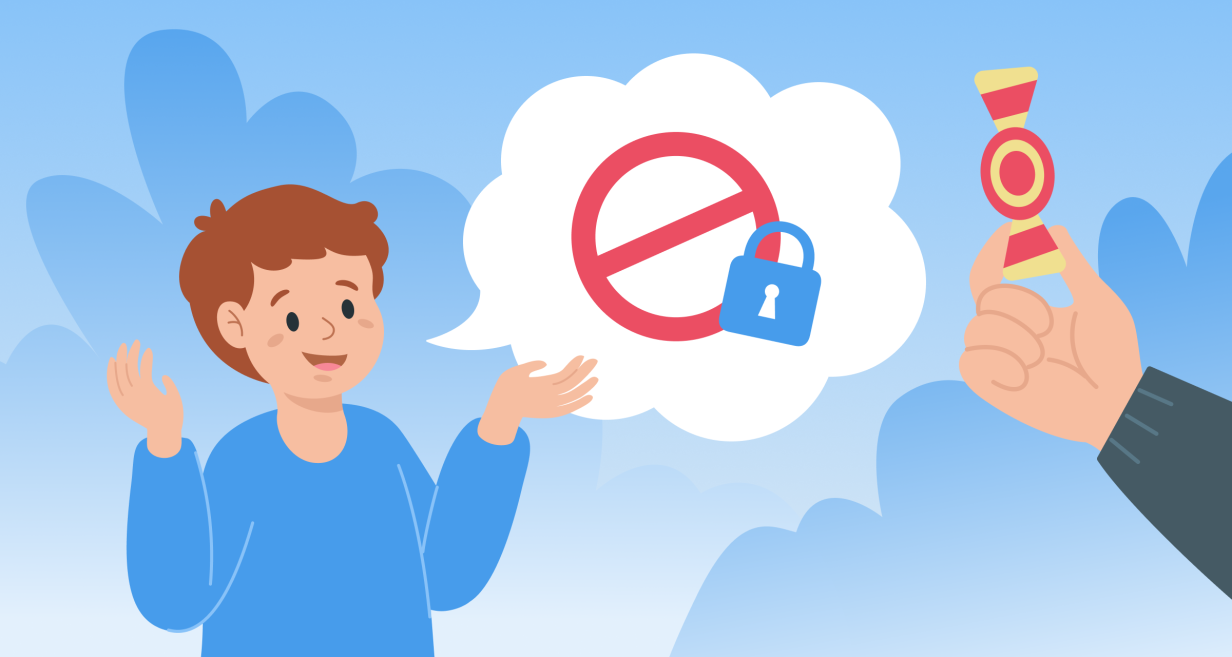
A bad secret is one that makes a child feel anxious, ashamed, or afraid. Especially one that an adult asks them to keep from mom or dad.
Teach them this rule: if someone asks you to keep something secret from your parents — that’s exactly what you need to tell your parents about. Adults who mean well don’t ask children to hide things.
Come back to this in different contexts over time — not as a scary warning, but as a calm, repeated fact. “Remember what we talked about with bad secrets? This would be one of those.”
Scenarios worth talking through
Children respond better in difficult moments when they’ve already thought about them — not in the heat of the moment, but calmly, at home, with you.
Hugs and kisses “to be polite.” Your child doesn’t have to hug or kiss anyone they don’t want to — not a grandparent, not an old family friend. “I’d rather high-five” or “Can I wave instead?” are perfectly fine alternatives. Back them up in the moment, including in front of other adults.
Photos and videos. No one should photograph or film your child without their consent especially in situations that feel strange like in a changing room or in a swimsuit. If an adult asks them not to mention a photo to you — that’s a warning sign.
Changing rooms and private space. In a locker room, bathroom, or shower, your child has the right to privacy from other children and from adults they know.
Medical examinations. This is a necessary exception, but a parent should be present, and the doctor should explain what they’re doing and why. Your child doesn’t have to stay silent or feel like they have to tolerate something they’re uncomfortable with.
“Don’t tell your mom.” Full stop. That’s exactly when they tell their mom.
Talking about this at different ages
Preschool (ages 3–6). Use the correct body part names in ordinary conversation without making it a heavy moment. Keep it simple: “Your body is yours. No one should touch you in a way you don’t like.” Read books on the topic together — it takes the tension out and makes it feel natural. At this age, children take rules in easily when they’re delivered calmly and repeatedly.
Primary school (ages 7–10). Talk in concrete situations: “If someone touches you in a way that feels wrong — you can say no and walk away. And tell me, whatever it is.” Explain the difference between good secrets and bad ones. Talk about who else they can go to if something happens — a teacher, the school counsellor, another trusted adult.
Teenagers (11+). Be direct — teenagers notice when they’re being managed around, and it shuts them down. Bring in the online dimension: pressure to share intimate photos, manipulation from a partner, strangers in their messages. Say explicitly: consent isn’t “they didn’t say no.” Consent is “they said yes” — and it can be taken back at any time.
How to respond if your child tells you something
This is the most important part of the whole lesson. How you react in the first few minutes will determine whether they come to you again.
Remove the guilt immediately. “This is not your fault. You did the right thing by telling me.” Even if they went along with something, didn’t say no, or stayed quiet at first — that is not on them.
Thank them for trusting you. “I’m really glad you told me. I know that wasn’t easy.” Say this out loud. They need to hear that they did the right thing.
Don’t interrogate. Don’t ask for details you don’t need. Don’t ask the same questions multiple times. Repeated questioning causes repeated harm. Ask only what you need to understand the situation.
Write it down. Record — in your own words, without interpretation — what your child told you and when. This may be needed later for a counsellor, a doctor, or law enforcement.
Get support. You don’t have to handle this alone. You can reach out to a child psychologist, a helpline, and if necessary, the police. Don’t delay, and don’t try to resolve serious situations within the family. There are people whose job it is to help with exactly this.
Practical tools
Role-play. Act out a scenario: “A stranger wants to hug you and you don’t want them to — what do you say?” Practice a few phrases until they come naturally. A child who has already said the words out loud will manage better than one who’s thinking about it for the first time under pressure.
Give them ready-made language. “I don’t like this,” “I don’t want to,” “I’m going to tell my mom” — short, calm, no explanation required. They don’t owe anyone a reason.
Talk to relatives. Let the grandparents, aunts, and uncles know: if your child doesn’t want a hug, you support that. Say it in front of your child. It shows them you mean it.
Revisit the circle of trust. Who, besides you, can they go to? Write down the names — and the numbers if needed — just as you did in the lesson about being out on their own.
Проверьте электронный ящик