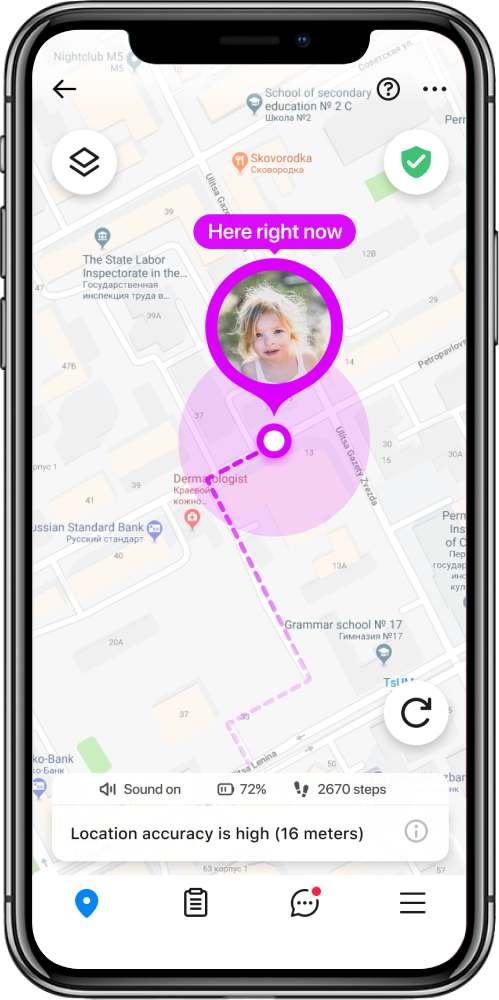










Findmykids data from 2,763 children in California shows that multi-platform app use is common by age 10. In a typical week, 62% of 10-year-olds used at least two apps with messaging or chat features. By age 12, half used three or more. The findings suggest that children’s digital lives extend across games, social platforms, and messengers well before their teenage years.
Published: October 2026
Region: California, United States
Population: 2,763 children ages 10–17 from Findmykids families using Android devices
Data source: Aggregated Findmykids app usage analytics
Study period: August 31–September 27, 2026
Key Findings
- 62% of 10-year-olds used at least two chat-enabled apps in a typical week, while 40% used three or more.
- 27% of children ages 10–11 used both a game with chat and a messenger in the same week.
- 44% of 10-year-olds used social apps, including Instagram, which appeared on 20% of their phones.
- 58% of children used Roblox during the four-week study period, compared with 55% who used TikTok.
- 36.7% used both Roblox and TikTok during the four weeks, while 21.6% used Roblox, TikTok, and Instagram.
- 41% of 17-year-olds used communication-enabled apps between midnight and 4 AM on at least two nights during the final study week.
Multiple Chat-Enabled Apps Are Common by Age 10
Findmykids analyzed app usage on Android phones belonging to 2,763 children ages 10–17 in California.
The analysis included social apps, messengers, and games with built-in chat features. YouTube and built-in texting apps were excluded from the count of chat-enabled apps.
Among 10-year-olds, 62.0% used at least two chat-enabled apps in a typical week, and 40.3% used three or more.
By age 12, those figures reached 70.5% and 50.3%, respectively.
Across the full sample, 73.8% used at least two chat-enabled apps in a typical week, while 55.8% used three or more.
Multi-platform app use is already common among the youngest children studied. Nearly three in four children ages 10–17 used at least two chat-enabled apps in a typical week.
Games and Messengers Often Appear on the Same Phone
Among children ages 10–11, 26.7% used both a game with chat and a messenger during a typical week.
Across the full four-week period, 37.6% used both categories during at least one week.
Roblox and WhatsApp were a particularly common combination among younger children. The pair appeared among 23.5% of 10- and 11-year-olds in the relevant app-pair analysis, compared with 12.5% for Roblox and Discord.
Other combinations included Brawl Stars with WhatsApp and Minecraft with WhatsApp.
Looking across the entire four-week period, 36.7% of children used both Roblox and TikTok, while 21.6% used Instagram, Roblox, and TikTok.
More than one in four children ages 10–11 used both a game with chat and a messenger in the same week. Roblox and WhatsApp were the most common pair in this age group.
These figures describe app usage on the same device, not conversations moving between platforms. A child might use Roblox to play with classmates and WhatsApp to communicate with family members.
The data cannot determine whether someone met in a game later contacted the child through another app.
Social App Use Is Already Visible Before Age 13
Social app usage differed substantially across age groups.
Among 10-year-olds, 44.1% used at least one social app during the four-week period. That share reached 67.2% among 13-year-olds and 88.1% among 17-year-olds.
Instagram was used on the phones of 19.9% of 10-year-olds, 45.9% of 13-year-olds, and 70.5% of 17-year-olds.
Roblox showed a different age pattern. It was used by 66.0% of 10-year-olds and 33.5% of 17-year-olds.
Discord also became more common across the age groups studied, appearing among 13.1% of 10-year-olds and 37.7% of 14-year-olds.
Instagram appeared on the phones of nearly one in five 10-year-olds, while Roblox was used by twice as large a share of 10-year-olds as 17-year-olds.
The findings indicate that the mix of platforms differs considerably between younger children and older teenagers.
However, app usage does not establish account ownership. Seeing Instagram used on a 10-year-old’s phone does not prove that the child has a personal Instagram account.
Time Spent in Communication-Enabled Apps Rises Across Age Groups
The median daily time spent in communication-enabled apps, excluding games and YouTube, was 24 minutes among 10-year-olds.
It reached 112 minutes among 13-year-olds and 146 minutes among 15-year-olds.
The proportion spending more than three hours a day in these apps was 21.9% among children ages 10–12, 33.1% among those ages 13–14, and 35.8% among teenagers ages 15–17.
Median daily time in communication-enabled apps was approximately six times higher among 15-year-olds than 10-year-olds. More than one-third of teenagers ages 15–17 spent over three hours a day in these apps.
These measures include watching videos, scrolling feeds, and reading content. They should not be interpreted as time spent messaging other people.
Late-Night App Activity Is More Common Among Older Teenagers
A separate analysis of September 21–27, 2026, examined app activity during late-night hours.
Among 10-year-olds, 17.6% used communication-enabled apps between midnight and 4 AM on at least two nights during the week.
The share was approximately 26% among 14-year-olds and 40.6% among 17-year-olds.
Late-night activity was also more common on nights before weekends than on nights before school days.
About two in five 17-year-olds used communication-enabled apps between midnight and 4 AM on at least two nights during the study week, compared with fewer than one in five 10-year-olds.
These findings describe when apps were used. They do not establish whether children stayed awake continuously, how much sleep they received, or why they opened particular apps.
What the Results Mean
The California findings show that children’s online activity is spread across multiple platforms from an early age.
Games, social apps, and messengers are not separate digital environments for many children. They are different parts of the same device-based experience.
Children’s digital lives span multiple platforms from an early age. Understanding the overall mix of apps may be more useful than focusing on a single platform.
For parents, this makes it useful to understand the overall range of apps a child uses rather than focusing exclusively on one platform.
The results also highlight the importance of discussing online boundaries before children become teenagers, including how to respond when someone asks to move a conversation to another app, share personal information, or keep an interaction secret.
However, the data does not show that children using more apps face a higher individual risk of harm. It measures app usage, not the content or safety of online interactions.
Methodology
This research is based on aggregated Findmykids app usage analytics from Android devices used by children in California.
Findmykids is a family location-sharing and safety app that also provides parents with information about app usage on supported children’s devices.
Population
The study included 2,763 children ages 10–17 from families using Findmykids.
California was assigned as a child’s home state when it was the state where the child spent the greatest number of days during the study period, with a minimum of 14 days.
The sample is limited to Findmykids families using Android devices.
Study Period
The main analysis covered four full weeks, from August 31 through September 27, 2026.
Late-night activity was analyzed separately for September 21–27, 2026.
Measures
An app was counted as used when it was active for at least 60 seconds during a day.
Chat-enabled apps included social apps, messengers, games with built-in chat, and apps designed for meeting new people.
YouTube and built-in texting apps were excluded from the chat-enabled app count and the corresponding screen-time analysis.
Weekly measures were calculated from eligible child-week observations. Four-week reach measures counted children who used an app or category at least once during the full study period.
Daily time figures represent medians, not averages.
Limitations
- The sample includes only children from Findmykids families using Android phones and is not representative of all children in California.
- The analysis compares different age groups during the same period. It does not track how individual children’s behavior changes as they grow older.
- App usage does not establish who owns an account or who a child communicates with.
- Findmykids does not access message contents or identify conversations with strangers.
- Using a game and a messenger during the same week does not demonstrate that a conversation moved between them.
- Screen-time figures include content consumption, not only messaging.
- Late-night app activity does not measure sleep duration or sleep quality.
Multi-platform app use is already widespread among 10-year-olds in the California sample. As children get older, social app use and time spent in communication-enabled apps become more prevalent, reinforcing the value of early conversations about digital safety.
Need More Data?
For research inquiries, additional information about this study, or media requests, contact the Findmykids Research Team.