















Children are completely surrounded by distractions. Between screens, busy schedules, noisy environments, and constant stimulation, gaining a child’s attention can feel like an uphill battle. In 2026, it’s harder than ever. That’s where attention grabbers and attention getters come in.
Used by parents, teachers, and other caregivers, these simple signals help redirect focus, improve communication, and reduce frustration. Whether you’re using them in the classroom, at home, or on the go, the right attention getter can make a big difference.
Key Takeaways
- Attention grabbers and attention getters help children shift focus quickly without repeated reminders or yelling.
- Many teachers use call-and-response techniques because students respond faster to short, familiar signals.
- Attention tools support classroom management, positive classroom culture, and smoother communication at home.
- Different attention getters work best for preschoolers, elementary school students, and older students.
- Digital attention grabbers can help when a child is too far away to hear a parent’s voice.
- Findmykids’ Loud Signal feature provides a practical way to reconnect when traditional attention signals aren’t possible.
Contents:
What Are Attention Grabbers and Attention Getters?

User34710080 / magnific.com
Attention grabbers are short phrases, sounds, actions, or signals used to capture children’s interest at the beginning of a lesson or activity. Attention getters are used to restore focus and bring children back on task when they become distracted.
In a classroom, teachers use attention getters to regain students’ attention during lessons, transitions, active learning activities, or when a class becomes distracted. Attention grabbers, on the other hand, are typically used at the start of learning activities to spark curiosity and engagement. At home, parents also use both techniques in everyday situations—from morning routines to homework time and managing distractions.
These tools work so well as go-tos because they interrupt distractions without requiring adults to repeat themselves over and over again.
Attention Getters vs. Attention Grabbers
The terms are often used interchangeably, but there are a few subtle differences, as outlined in the table below:
| Attention Getters | Attention Grabbers |
| Used during or after activity | Used at the start of activity |
| Restore focus | Spark initial attention |
| Bring children back on task | Engage curiosity |
| Often used for transitions or distractions | Often used to launch learning moments |
⠀
For example, an attention getter might be:
- Parent: “Hocus pocus!”
- Child: “Everybody focus!”
This is used to quickly regain a child’s attention and bring them back to the task or routine.
An attention grabber might be a parent clapping a rhythm or using a visual cue before starting a new activity at home to get a child engaged.
Why Kids Respond Better to Short Signals
We all know that children process information differently from adults. Long explanations often compete with dozens of other distractions. And quite frankly, nobody has the time for those long explanations, anyway!
Research on learning and education shows that short, predictable signals help learners shift attention more efficiently than repeated verbal reminders, which is one reason why teachers rely on call and response techniques. When students hear a familiar phrase, they immediately know what’s expected.
This works because children have limited attentional resources. Short, familiar cues reduce the mental effort needed to understand what’s happening next and help them switch focus more efficiently than lengthy explanations.
Kids respond well to these systems because they:
- Are predictable
- Reduce confusion
- Create clear expectations
- Help children focus on the next thing
- Turn transitions into something fun
Whole-brain teaching and brain-teaching methods often use attention getters because they engage multiple senses at once. In other words, students respond to the sound, the phrase, the movement, and the routine simultaneously.
Why These Tools Matter in Real Parenting
Marinatynik / magnific.com
A generation ago, most distractions were limited to television, toys, and conversation. Today, children encounter endless stimulation from devices, games, videos, notifications, and more. Their attention, in other words, is constantly competing with other sources of entertainment.
Verbal repetition is often ineffective here; many parents find themselves repeating the same instruction multiple times: “Put your shoes on. Put your shoes on. Put your shoes on.”
Eventually, frustration builds (for both the parent and the child who is ultimately on the receiving end of that frustration). Attention signals, however, can help break that cycle in everyday parenting situations.
Another issue is that our environments tend to be quite noisy. Whether at school, in a shopping centre, on a sports field, or during family travel, many situations make it difficult for children to hear a parent’s voice. A high-pitched voice or repeated shouting often becomes just more background noise.
Let’s not forget that attention is a limited resource. Just as adults lose focus, kids can only devote a limited amount of attention at any given moment. Without attention tools, communication easily breaks down into repetition, frustration, and conflict.
Attention Grabbers in the Digital Age
Modern technology has changed everything about how children seek and receive attention. Social media platforms, like TikTok and Instagram, rely on exciting validation loops, where likes, comments, and notifications create constant rewards that encourage frequent engagement.
As a result:
- Children may become accustomed to immediate feedback
- Offline communication may feel less stimulating
- Patience for waiting may decrease
- Silent attention seeking through devices becomes more common
Often, parents find themselves competing at all hours of the day with screens for focus. Traditional attention getters are still useful, but these new digital environments present fresh communication challenges that can often only be addressed head-on.
45 Attention Getter and Grabber Examples for Kids
Kids not paying attention at home, in public places, or during daily routines? Here are quick and easy ways parents can regain their child’s focus.
Call-and-Response Attention Grabbers
These classic call-and-response patterns work especially well at home, during morning routines, getting ready to leave, or transitioning between activities. They can be used with toddlers, school-age kids, and even teens in a playful but structured way:
- Hocus pocus → Everybody focus
- Macaroni and cheese → Everybody freeze
- Shark bait → Hoo ha ha
- Holy moly → Guacamole
- Hear ye, hear ye → All eyes here
- Vanilla Ice → Collaborate and listen
- Great balls → Fire
- Jelly time → Peanut butter time
- Class class → Yes yes
- Ready set → You bet
- Hands on top → Everybody stop
- 1-2-3 eyes on me → 1-2 eyes on you
- Teamwork → Makes the dream work
- To infinity → And beyond
- Knock knock → Who’s there
Rhyming Attention Grabbers
These short rhymes are especially useful during everyday home situations like getting dressed, cleaning up toys, or leaving the house, helping kids quickly transition between activities. Some ideas:
- Flat tire
- Freeze please
- Stop and bop
- Ready spaghetti
- Time to shine
- Listen and glisten
- Eyes and ears
- Quiet riot
- Sit and fit
- Pause because
Movement-Based Attention Grabbers
Movement-based attention grabbers work well at home when children are restless, distracted by screens, or need help transitioning between activities:
- Raise one hand
- Touch your head
- Touch your shoulders
- Hands on knees
- Stand and stretch
- Clap once
- Clap in, clap back
- Point to the sky
- Hands behind your back
- Circle time freeze
Quiet Attention Getters
These quieter signals are useful in situations where parents don’t want to raise their voice—for example, in public places, at home with sleeping siblings, or during calm routines. Try these muted call-outs:
- Silent hand raise
- Finger countdown
- Visual cue card
- Flashing classroom light
- Peace sign signal
Attention Getters for Noisy Places
Last but not least, when everyone is talking, traditional attention getters might not work. In these situations, parents or caregivers often rely on stronger auditory or visual cues to quickly bring the group back together:
- Ring a bell or keychain chime
- Use a soft chime sound
- Clap a rhythm and have the child repeat it
- Turn lights off and on once (at home)
- Use a short sound cue (phone, watch, app)
- Start a countdown: “5–4–3–2–1”
- Say: “If you can hear me, clap once”
- Use a small object (flag, card, or sign)
- Raise a visible hand signal
- Tap a table or surface rhythmically
When Your Child Cannot Hear You: Digital Attention Getters
Findmykids app
Traditional attention getters work best when kids are nearby; parents can clap in a pattern, use a phrase, or raise a hand. Whatever it is, children see the signal and respond.
But what do you do when your child is at school, at practice, walking home, or at a friend’s house? What if they’re in a crowded shopping mall, or carrying their phone inside their backpack? If that’s the case, you need a different way to capture attention.
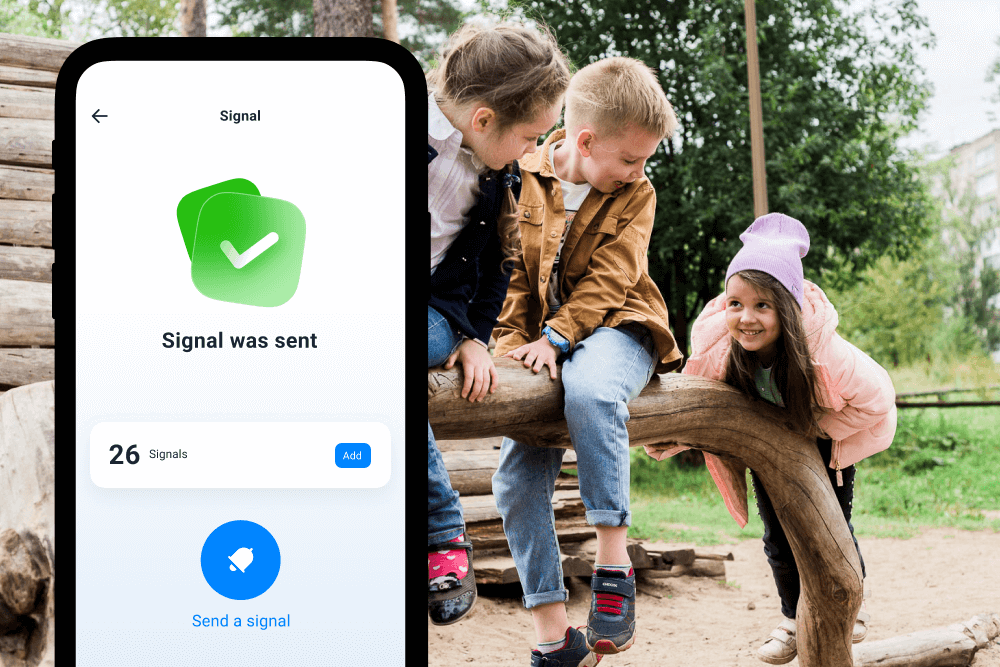
This is where the Loud Signal feature in Findmykids can be so helpful, especially when used as a digital attention getter.
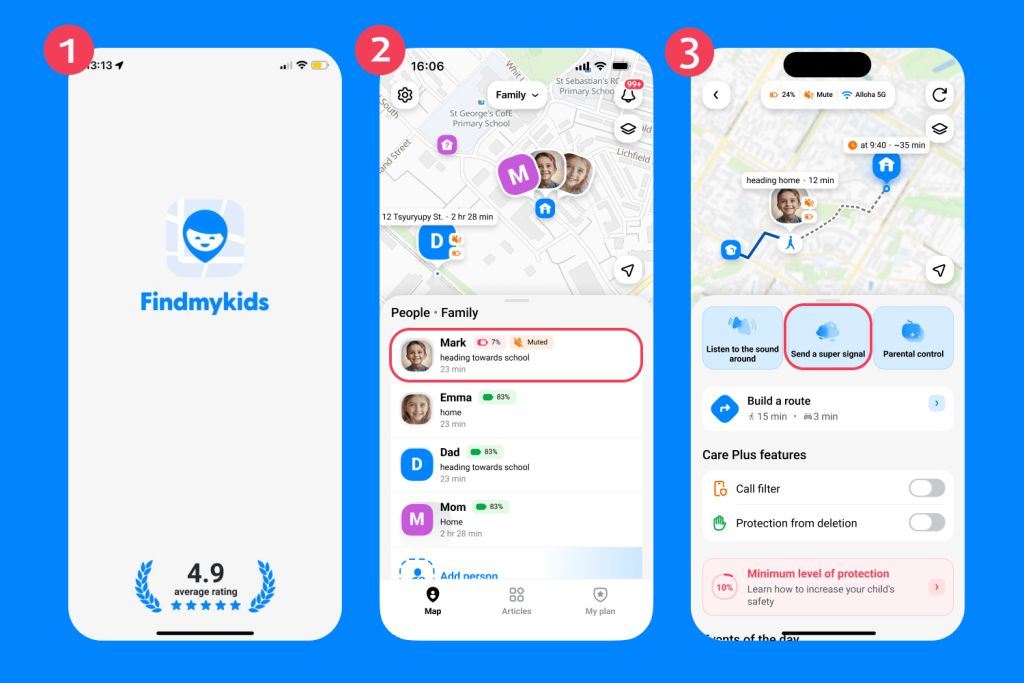
Findmykids app
Unlike a standard notification that may be missed, the feature sends a loud alert that can help a child notice an important message from a parent. It works best when families agree on expectations beforehand, for example: “If the loud signal plays, check your phone and contact home.” Now, you can turn what might be viewed only as a control mechanism into a family safety agreement.
These loud signals can be especially useful in the following scenarios, helping to accomplish what just a voice cannot do on its own:
- A child misses a change in pickup plans
- A phone is buried inside a backpack
- A child doesn’t hear a call during sports practice
- A family becomes separated in a crowded venue
- A parent needs to restore contact quickly
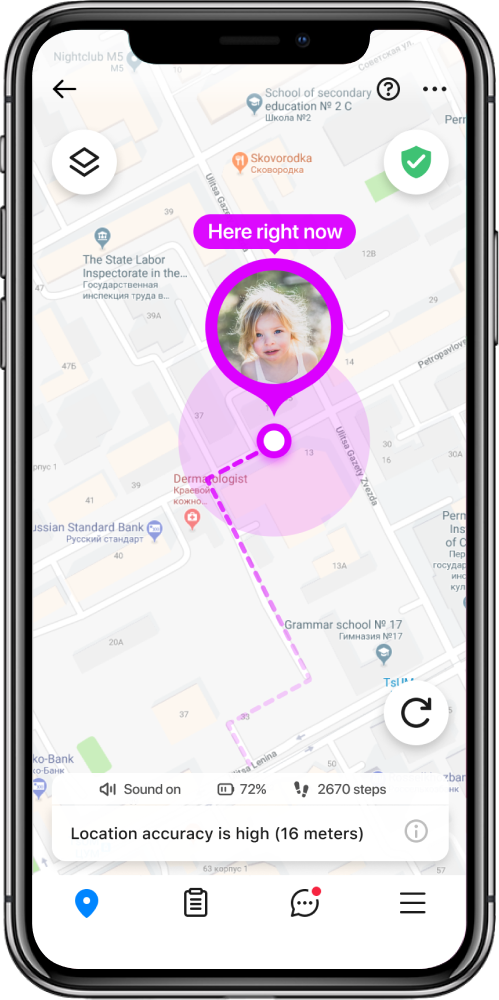
In addition to the Loud Signal, Findmykids has several other features to help families stay connected, including GPS location tracking, route history, battery monitoring, location notifications, screen time management, and family communication tools. When used together, these tools help reduce uncertainty while supporting strong family communication.
If you’re looking for a simple way to stay connected with your child throughout the day, you can try the Findmykids app. It helps parents use tools like the Loud Signal and real-time location tracking to stay in touch and respond quickly when needed!
Best Attention Getters and Grabbers by Age
Not all attention getters work equally well for kids of different ages. Below, we break down our favorite attention getters by age.
Preschool Children
At this stage, attention grabbers work especially well both at home and in early learning settings, as young children respond best to:
- Songs
- Rhymes
- Movement
- Circle time routines
Elementary School Kids
The goal with elementary school attention getters should be to create an engaging environment while supporting learning. Elementary classes often respond well to:
- Call and response
- Group participation
- Active learning activities
- Classroom routines
Tweens and Teens
At this age, traditional attention getters become less effective, and focus shifts toward communication and structure rather than signals. What works best includes:
- Respectful communication
- Established expectations
- Digital reminders
- Family agreements
How to Use Attention Signals Effectively

The Yuri Arcurs Collection / magnific.com
Both of these tools work best when they become part of a predictable routine. Whether they’re used in a classroom, during circle time, or at home, consistency helps children understand what is expected when they hear a specific phrase or signal.
To get the best results, start by choosing one or two go-signals, rather than introducing brand-new ones every week. Then, follow these tips:
- Practice them regularly during calm moments before relying on them in complicated or distracting situations.
- Use the same phrase consistently so children can build familiarity with it.
- Make expectations clear. Children should know exactly what to do when they hear the signal, whether that means becoming quiet, looking at the speaker, or stopping an activity.
- Reinforce positive behavior when children respond appropriately.
- Wait for the desired response before continuing. Rushing ahead before children pay attention can reduce the effectiveness of the signal.
- Keep interactions engaging and fun, especially with younger children who often respond best to playful routines.
Remember, you always need to match the attention signal to the child’s age and environment. A silly rhyme might work well with preschool learners, but older students will likely respond better to a simple verbal cue or agreed-upon signal. What matters most is that the attention getter remains predictable and easy to recognize.
When used consistently, attention signals can save time, reduce frustration, and create smoother transitions between activities. Over time, kids begin to associate these signals with specific actions, making it far easier to regain focus without repeated reminders.
Mistakes to Avoid When Using Attention Getters
Like any strategy, even the best attention signals can lose their effectiveness when they’re used inconsistently or without clear expectations. And like any communication tool, they work best when children understand both the signal and the response that should follow.
Some of the most common mistakes include:
- Changing signals every week before children have had time to learn them.
- Using too many signals at once, which can create confusion.
- Ignoring follow-through after gaining a child’s attention.
- Turning every signal into a lengthy lecture or correction.
- Expecting immediate perfection the first few times a new signal is introduced.
- Failing to practice during calm situations before using the signal in more challenging environments.
Another common mistake? Overusing attention getters and/or grabbers. Don’t overdo it! If a signal is repeated constantly throughout the day, children may begin to tune it out or view it as just more “white noise” in the background. Attention signals are most effective when reserved for moments when focus truly needs to be redirected.
You also should avoid using attention signals as a substitute for meaningful communication. While these tools can help capture students’attention quickly, they need to be followed by clear instructions, positive guidance, and age-appropriate expectations.
Building Better Communication in a Distracted World
Whether you use them in a classroom throughout the school year, during circle time, at home, or on a busy weekend outing, attention signals help kids focus on what’s important.
Teachers have long used attention getters to support classroom management, encourage active learning, and foster a positive classroom culture, but parents can use many of the same strategies to improve communication, reduce frustration, and strengthen family routines.
And when traditional methods aren’t enough, digital tools like Findmykids’ Loud Signal provide yet another way to restore contact and make sure all important messages are heard.
Remember: the goal isn’t to simply get everyone’s attention when class ends or begins. The goal is to create stronger communication, clearer expectations, and more meaningful connections between adults and children.
FAQs
What are attention getter examples for kids?
Popular examples include Hocus Pocus, Everybody Focus; Macaroni and Cheese, Everybody Freeze; Shark Bait, Hoo Ha Ha; clap in patterns; silent hand raises; and movement-based signals.
What is the best attention getter for a classroom?
The best kids’ attention getter depends on the age group. Call and response systems are often effective because students respond quickly, and the whole class can participate.
How can I get my child’s attention without yelling?
Use a consistent phrase, hand signal, visual cue, or agreed-upon attention grabber. Predictable signals often work better than repeated reminders even without requiring the teacher to shout.
Read also: 8 Reasons Why We Yell at Our Kids and How to Stop.
What attention getters work in noisy places?
Hand gestures, whistles, visual signals, and digital tools such as the Findmykids’ Loud Signal can help capture attention when children cannot hear a voice clearly.
What should I do if my child does not answer the phone?
Families can establish communication expectations in advance. Features such as Findmykids’ Loud Signal can help restore contact when a child misses calls or notifications.
Sources & References
- Gesture helps learners learn, but not merely by guiding their visual attention, Developmental Science, 2018
- Attention-Getter, Whole Brain Teaching Basics, Whole Brain Teaching, 2026
- Social Media and Youth Mental Health: The US Surgeon General’s Advisory, Department of Health and Human Services, 2023
- Attention span during lectures: 8 seconds, 10 minutes, or more?, AJP Advances in Physiology Education, 2016
- 7 Attention-Getters to Use Instead of Raising Your Voice, Edutopia, 2022
- The development of sustained attention in children: the effect of age and task load, PubMed, 2006
Cover image: Romeo22 / magnific.com
Проверьте электронный ящик