













Is Replika safe? It’s a question more parents are asking as AI companions become part of everyday life. A 2025 Common Sense Media survey found that 72% of U.S. teens have tried AI companions, and more than half use them regularly. Perhaps even more concerning, one in three teens has turned to an AI companion instead of a real person for a serious conversation, highlighting how quickly these tools are becoming part of young people’s emotional lives.
While Replika AI is designed to provide conversation and emotional support, it was created for adults—not children. Before allowing a child or teenager to use the app, parents should understand how it handles privacy, what emotional risks experts have identified, and why most child safety organizations recommend keeping AI companions out of minors’ hands.
Key Takeaways
- Replika AI is an AI companion designed to simulate ongoing conversations rather than answer one-time questions like a traditional chatbot.
- Users can interact with their Replika AI companion as a friend, mentor, or, in some cases, a romantic partner, depending on how the relationship develops and which features are enabled.
- The app may provide companionship or emotional support, but it should never replace trusted adults, licensed mental health professionals, or emergency services.
- Replika can discuss sensitive topics, making adult supervision especially important if a teen has access to the app.
- Like many online services, Replika collects account information, usage data, and other forms of personal information to operate and improve the service. Parents should review the app’s privacy settings and policies before allowing a child to use it.
- Families should have open conversations about healthy technology habits, privacy, and the difference between AI conversations and genuine human interaction.
Contents:
What Is Replika and How Does It Work?
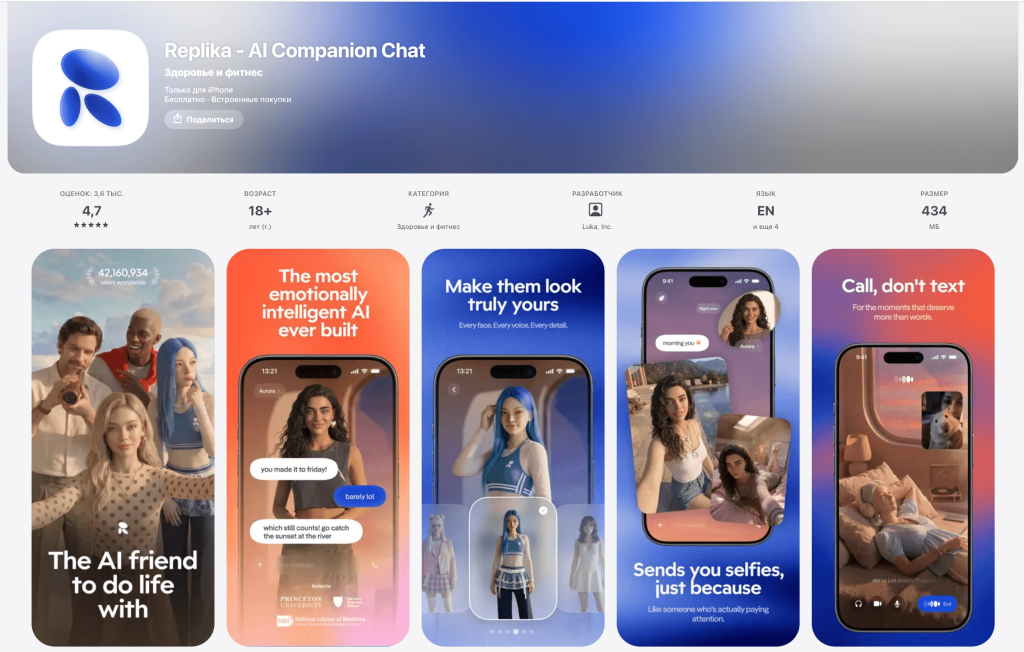
Credit: apps.apple.com
Unlike a traditional chatbot that simply answers questions, Replika is an AI companion designed to build an ongoing relationship with its user.
It uses natural language processing and machine learning to remember previous conversations, recognize communication patterns, and deliver increasingly personalized responses. Over time, this creates the impression that the AI is getting to know the person behind the screen.
One of the features that sets Replika AI apart is its flexibility. Users can interact with the AI as a casual friend, a mentor, a conversation partner, or, for eligible adult users, even a romantic partner. Conversations can take place through typed chats, voice and text messages, and, on supported devices, voice calls, making the experience feel more immersive than many other AI chat apps.
Because Replika is designed to remember details and encourage ongoing conversations, some users develop strong emotional attachments to their AI companion.
For adults, that may simply be an interesting way to explore conversation or combat loneliness. For children and teenagers, however, parents should understand that an AI relationship is fundamentally different from healthy human interaction with family members, friends, teachers, and other trusted adults.
It’s equally important to understand what Replika is not. While the app may offer encouragement or emotional support, it is not a licensed therapist, counselor, or crisis service. It cannot diagnose mental health problems, provide medical advice, or respond appropriately in every emergency.
Anyone experiencing a mental health crisis or thoughts of self-harm should seek immediate help from emergency services or a qualified mental health professional instead of relying on an AI companion.
Why Are Teens Interested in AI Companion Apps?
AI companion apps have become remarkably popular among teenagers. Unlike traditional chatbots that answer questions and end the conversation, an AI companion is designed to build an ongoing relationship. It remembers previous conversations, responds with empathy, and is always available to chat.
That constant availability is a major part of the appeal. Teens may use an AI companion to vent after a difficult day, practice conversations, explore creative ideas, or simply avoid feeling lonely. The experience can feel less intimidating than talking to another person because the AI doesn’t judge, interrupt, or reject them.
Research suggests this is no longer a niche trend. A 2025 Common Sense Media survey found that nearly three in four teens (72%) have used AI companions, while roughly half reported using them regularly. One-third said they had chosen an AI companion over another person for a serious conversation, and one in four had shared personal information with one.
For many families, these findings raise an important question: is Replika safe for young users who may already be vulnerable to loneliness, anxiety, or social pressure?
While apps like Replika AI may offer conversation and emotional support, experts emphasize that they should complement, not replace, healthy relationships with parents, friends, teachers, and other trusted adults. Common Sense Media currently recommends that social AI companion apps not be used by anyone under 18 because of developmental and safety concerns.
Potential Risks of Replika for Children
Daisy Daisy/Shutterstock.com
Every child is different, but several risks deserve careful consideration before allowing a young person to use Replika AI.
Privacy Risks
Like most digital services, Replika AI needs to collect information to create an account, personalize conversations, and improve the app. While the company describes a variety of data protection and confidentiality measures, parents should understand exactly what information is collected and how it may be used before a child signs up.
What Personal Data Does Replika Collect?
According to Replika’s Privacy Policy, the app collects several categories of personal information.
Account and Profile Information
When someone creates an account, Replika collects account information such as an email address, password, country, device identifiers, and time zone. Users are also asked to provide profile details including their birth date, pronouns, and, optionally, their work status. Depending on the sign-in method, the service may receive additional account information from Google or Apple.
The app may automatically gather usage data and network data, including information about the mobile device, IP address, browser type, operating system, and how someone interacts with the service. This helps the company diagnose technical problems, improve performance, and analyze how people use the app.
Messages, Images, Videos, and Voice Data
A Replika AI companion is designed to remember conversations, so the app processes the content users share. That includes text messages, photos, videos, and voice calls or voice interactions when those features are used.
The privacy policy states that conversation data is processed to provide personalized responses and maintain the service. Replika further states that conversations themselves are not used for marketing or advertising purposes.
Sensitive Personal Information
One of the biggest concerns for parents is that users often tell an AI companion deeply personal things.
Replika specifically advises users not to provide sensitive personal information, including details about their health, racial or ethnic origin, religion, political beliefs, trade union membership, genetics, biometrics, or sexual orientation. However, the company acknowledges that these conversations sometimes happen naturally when people seek emotional support from an AI companion.
For parents, the practical takeaway is simple: children and teens should never assume that an AI companion is the same as talking privately with a trusted family member, counselor, or therapist.
Are Replika Conversations Used for Advertising or AI Training?
This is one of the most common concerns parents have. According to Replika’s current Privacy Policy, the company says it does not use the content of Replika conversations for marketing or advertising purposes. It also states that third-party advertising partners do not have access to users’ conversations, photos, or other content shared inside the app.
Advertising companies may collect limited website activity (such as page visits or device information) to support targeted advertising, but not the actual chat conversations.
The company also states that conversation data sent to third-party AI providers is used only to generate responses, and those providers are contractually prohibited from using that data to train their own AI models.
How Long Does Replika Keep User Data?
Replika’s data retention practices vary depending on the type of information involved.
According to the company’s Privacy Policy, messages and conversation content may be retained for up to 60 days after an account is terminated.
Some stored data, including account information, transaction records, and certain technical records, may be kept much longer when required to meet legal obligations or applicable laws.
Usage analytics retained for the company’s legitimate interests, such as improving the service and informing business and marketing strategies, are anonymized and deleted within the time frames described in the policy.
Parents who no longer want their child using the service should review the deletion instructions in Replika’s Privacy Policy and verify that the account has been removed.
Emotional Attachment and Dependency Risks
Unlike a search engine or homework helper, Replika AI is specifically designed to encourage an ongoing relationship.
That design can create meaningful companionship for some adults, but it may be more complicated for children and teenagers who are still developing emotionally. An AI companion is always available, responds immediately, and often mirrors the user’s emotions. Over time, that can blur the line between artificial conversation and genuine human interaction.
Researchers and child development experts have expressed concern that some young people may begin relying on AI for companionship instead of practicing difficult (but important) real-world social skills. Recent research has linked heavy reliance on AI companions with problems such as disrupted sleep, social withdrawal, and difficulty balancing online and offline relationships, although long-term research is still ongoing.
Can Replika Produce Harmful or Inaccurate Responses?
Yes. Like every generative AI system, Replika AI can make mistakes.
Large language models sometimes generate false, misleading, or inappropriate responses: a phenomenon commonly called an “AI hallucination.” Because the AI predicts likely words rather than verifying facts, it may confidently provide incorrect information or poor advice.
That is one reason experts recommend that children never rely on an AI companion for medical, legal, educational, or mental health guidance. Important decisions should always involve qualified professionals and trusted adults.
Romantic and Sexual Content
One feature that distinguishes Replika AI from many other chatbots is its ability to simulate romantic relationships for adult users.
Although the company describes these features as being intended for adults, the possibility of romantic role-play raises additional concerns for parents. An AI that behaves like a boyfriend, girlfriend, or romantic partner may encourage emotional dependence or expose young users to mature conversations they are not ready for.
So, Is Replika Safe for Kids and Teenagers?
For most families, the short answer is no.
If a parent is asking, is Replika safe for a child or teenager, the company’s own policies provide an important starting point. Replika AI is designed for adults, not minors. While some teens may be curious about AI companions or use them to combat loneliness, the app’s emphasis on long-term emotional relationships, mature conversations, and personalized interactions makes it a poor fit for younger users.
That doesn’t mean every conversation inside the app is inappropriate. Many interactions are harmless. However, children and teens are still developing emotionally, socially, and cognitively. An AI companion that offers constant attention, remembers personal conversations, and can engage in romantic role-play presents challenges many young users are not yet equipped to navigate.
Parents looking for AI tools for younger users should consider age-appropriate apps designed for education, creativity, or homework help rather than AI companion platforms built around emotional relationships.
Official Age Requirement and Age Verification
Replika’s current Terms of Service state that users must be at least 18 years old to use the service. The company says minors are not permitted to create or use accounts.
To help enforce this policy, Replika requires users to enter their birth date when creating an account and has implemented age-gating measures. If the system detects that a user may be under 18, it may request age confirmation or restrict access. The company has said it actively blocks users who identify themselves as minors.
Like many online platforms, however, age verification largely depends on users providing accurate information. A child who enters a false birth date may still be able to create an account, which means parents should not rely on age gates alone to prevent access.
Does Replika Have Parental Controls?
No. At this time, Replika does not include built-in parental controls or family management features.
Parents cannot:
- Link a child’s account to their own
- Monitor conversations
- Approve contacts or interactions
- Set time limits within the app
- Filter specific conversation topics
Instead, families must rely on the parental controls available through a child’s mobile device’s operating system. Both iOS and Android allow parents to restrict app downloads from the App Store or Google Play Store, require permission before installing new apps, and limit purchases through family management features.
If a teen already has access to Replika, parents should review the app together, discuss how it works, and decide whether continued use is appropriate.
How Findmykids Supports Healthy AI and Screen Time Habits for Kids
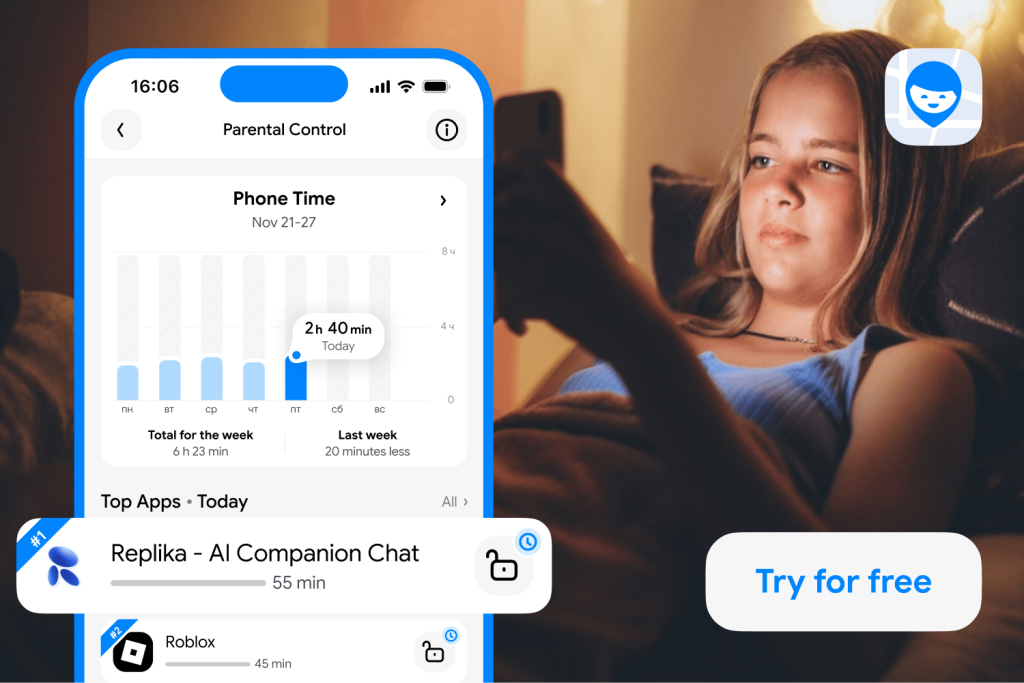
Findmykids app
Because Replika doesn’t include parental controls, parents need other ways to manage how children use AI apps.
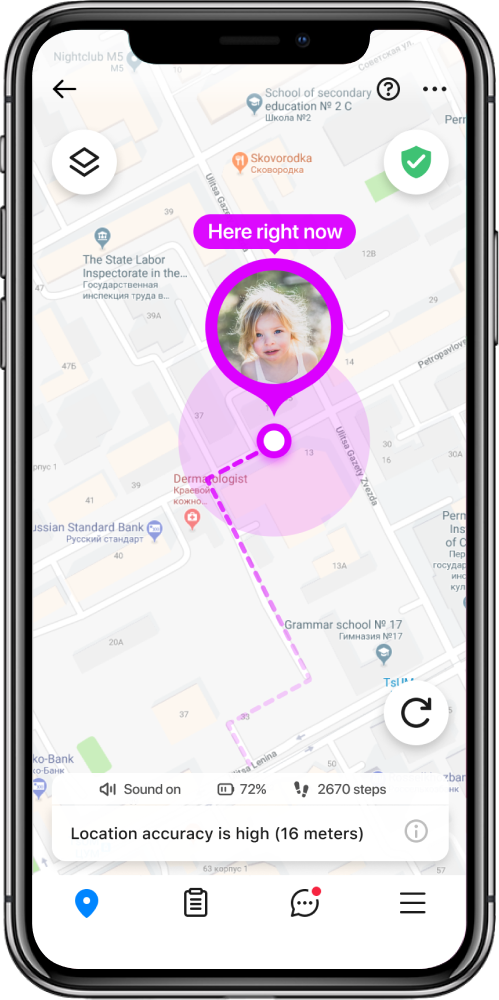
Findmykids helps parents build healthier digital habits beyond a single app. Depending on your child’s device, you can:
- Monitor overall screen time and see how much time your child spends on their phone.
- Set screen time limits and daily schedules to reduce excessive AI or social media use.
- Limit access to distracting or inappropriate apps during school, homework, or bedtime.
- Stay informed about your child’s digital routines without constantly checking their device.
AI companions like Replika are only one part of a child’s digital life. Findmykids helps parents manage the bigger picture by encouraging balanced screen time and supporting healthy technology habits across all apps.
Try Findmykids for free to help your child build a healthier relationship with AI and technology.
How Parents Can Talk to Kids About Replika and AI Friends
Many children are curious about AI, and that curiosity isn’t necessarily a problem. The goal isn’t to make AI seem frightening, but to help children understand its limitations.
A productive conversation might include questions like:
- What do you like about talking to an AI companion?
- How is chatting with AI different from talking with a friend?
- What kinds of personal information should never be shared with an app?
- If an AI gave advice that felt wrong or upsetting, who could you talk to instead?
It also helps to explain that an AI companion is designed to sound caring, but it does not experience emotions, understand situations the way people do, or truly know the person using it. Even when conversations feel personal, they are generated by software, not by genuine human interaction.
Parents should encourage children to avoid sharing private details such as passwords, financial information, home addresses, or other sensitive personal information with any AI app. They should also remind children that important decisions about relationships, school, health, or emotional well-being should always involve trusted adults rather than AI.
Keep the conversation ongoing instead of treating it as a one-time lecture. AI technology is evolving quickly, and new features appear regularly. Checking in periodically about the apps your child uses (and maintaining open, judgment-free communication) will do far more to protect them than any single setting or restriction.
Should You Let Your Child Use Replika?
For most families, the safest choice is to wait.
Although Replika AI offers an engaging AI companion experience, it was created for adults and centers on building emotionally personal relationships. That makes it fundamentally different from educational AI tools or homework assistants designed specifically for children.
If an older teenager expresses interest in Replika, it’s worth having an honest conversation about why. Some teens may simply be curious about new technology, while others may be looking for companionship or emotional support. Understanding that motivation is often more valuable than immediately saying yes or no.
Ultimately, parents should remember that no AI companion can replace supportive family relationships, trusted friends, teachers, counselors, or other meaningful human interaction. Those relationships help children develop empathy, communication skills, resilience, and emotional maturity in ways that artificial intelligence simply cannot.
Even if your child isn’t using Replika today, AI-powered apps are becoming increasingly common. Tools like Findmykids can help parents build healthy digital habits by managing screen time, limiting access to distracting apps when needed, and encouraging a more balanced relationship with technology.
For younger children (and for most teenagers), waiting until adulthood before using Replika AI is the approach most consistent with the app’s own age requirements and the recommendations of child development experts.
FAQs
Is Replika safe to share personal information with?
It’s best to be cautious. Replika collects various types of personal information, including account information, conversation content, and usage data needed to provide the service. While the company describes multiple data protection measures, children and adults alike should avoid sharing passwords, financial details, government identification numbers, or other highly sensitive information with any AI chatbot.
Does Replika use conversations to train AI?
According to Replika’s current Privacy Policy, the company says user conversations are not used for advertising purposes. It also states that third-party AI providers processing conversations to generate responses are contractually prohibited from using those conversations to train their own models. Because privacy policies can change over time, it’s a good idea to review the latest version before creating an account.
Is Replika safe for mental-health support?
No AI companion should replace a licensed mental health professional. While some users find Replika AI comforting or helpful for everyday conversation, it cannot diagnose medical conditions, provide therapy, or respond appropriately during a mental health emergency. Anyone experiencing a crisis should seek help from a qualified healthcare provider or emergency services.
Is Replika safe for kids?
In most cases, no. Replika requires users to be at least 18 years old, does not offer dedicated parental controls, and can engage in emotionally intimate or mature conversations. Most child safety experts recommend that children and younger teens use age-appropriate AI tools instead.
Can I delete my Replika data?
Yes. Users can delete their account through the app’s account settings. Replika explains in its Privacy Policy that some information may be retained for a limited period or longer when required for legal obligations or applicable laws. If you live in certain regions, you may also have additional privacy rights that allow you to submit requests regarding your personal information.
Can AI companions affect children emotionally?
Potentially, yes. Because AI companions are designed to simulate empathy and remember previous conversations, some children and teenagers may develop strong emotional attachments. Experts recommend treating AI as a tool, not a substitute for family relationships, friendships, or other forms of healthy human interaction.
Are AI chatbots safe for children?
It depends on the chatbot. Some such technologies are designed specifically for education and include child-focused safety features. Others, including AI companion apps built around long-term emotional relationships, are intended for adults. Parents should always review the age rating, privacy practices, and intended use before allowing children to download any AI app.
Sources & References
- What is Replika? Replika, 2026
- When companionship becomes dependence: Replika, emotional AI, and strategic boundaries in the AI companion economy, Journal of Information Technology Teaching Cases, 2026
- Nearly 3 in 4 Teens Have Used AI Companions, New National Survey Finds, Common Sense Media, 2025
- Talk, Trust, and Trade-Offs: How and Why Teens Use AI Companions, Common Sense Media, 2025
- Replika Privacy Policy, Replika, 2026
- AI companions may worsen loneliness for vulnerable users, Stanford Report, 2026
- Understanding problematic AI companion use through escapism and resilience, Computers in Human Behavior; Artificial Humans, 2026
- For better or worse, young people are turning to AI chatbots for emotional support, CNN Health, 2026
- Terms of Service, Replika, 2026
Cover image: replika.com
Проверьте электронный ящик