














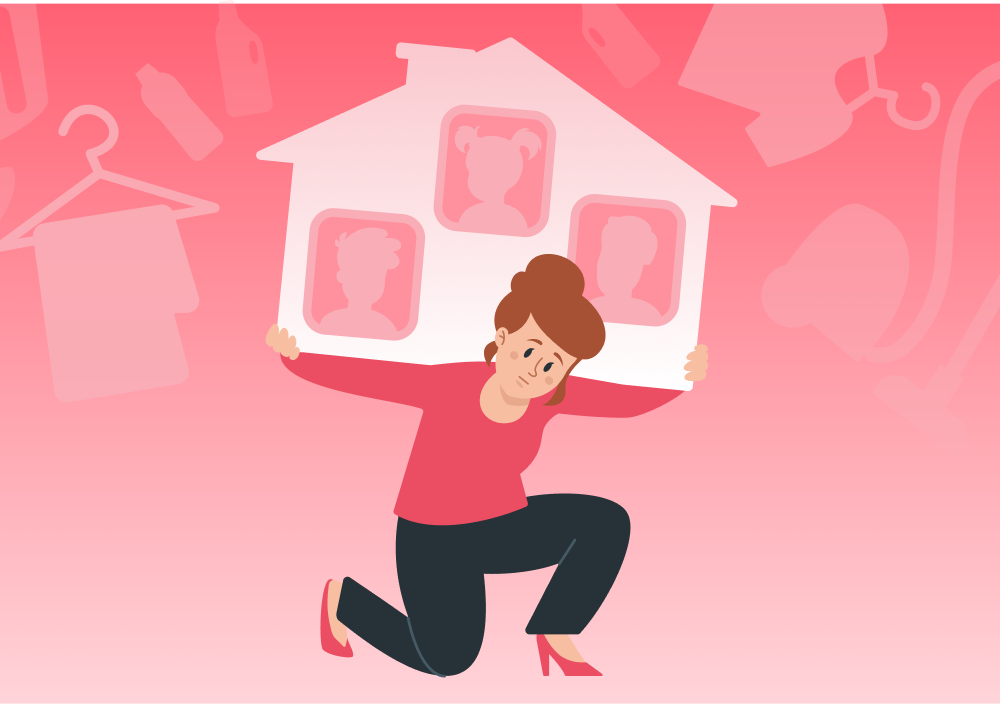
Who is the Default Parent — and Why Is It Almost Always Mom?

In 2023, American sociologists sent letters to schools from fictional parents — with contact info for both a mom and a dad — and asked the principal to call one of them back to discuss the child’s enrollment. In 60% of cases, they called the mom.
📊 When the letter noted that the dad had a lot of free time and the mom didn’t, dads got called more often — 74% of the time. But moms still got the call even when they were the one explicitly described as busier.
The same pattern shows up with daycare teachers, coaches, and doctors — they tend to reach out to moms too. One phone call seems like a small thing, but over the course of a year, these calls add up to yet another line item of parental time that falls disproportionately on moms.
Carrying It All
📊 A recent study found that mothers take on 71% of the mental load in a family — planning, scheduling, organizing — while fathers handle just 45%.
Even when dad is actively involved in family life, all that background brain-work somehow still sticks to mom. And money doesn’t really change the equation: moms earning over $100,000 a year genuinely spend less time on household chores, but their mental load is no smaller than that of moms earning less.
Doing It, Without Any Joy
💬 In 2017, French artist Emma published “You Should’ve Just Asked.” In the comic, her partner is washing the dishes — but she’s the one who notices the detergent has run out, remembers the daycare paperwork, and keeps her mother-in-law’s birthday in her head. When she complains to her partner that all of this falls on her, he replies: “Well, you could’ve just asked.” That’s the whole point — the very fact that you have to ask and remind is itself the load. The comic went viral worldwide precisely because so many women finally saw themselves in it.
⚠️ Mental load isn’t just end-of-day tiredness. Seven in ten moms describe themselves as overwhelmed, and nearly half report anxiety or depression. A large-scale U.S. study also found that the share of moms rating their mental health as “excellent” has dropped noticeably over the past few years.
What Can Actually Change This
At the level of school, doctor, or coach. If you want them to call dad, say so directly. According to the research, a simple instruction to “call dad” actually works — it just has to be stated clearly. If a form only has one field for “contact person,” put dad’s name in it first.
At the family level. Splitting responsibilities “50/50” in words isn’t enough. What works better isn’t a vague “let’s share the chores,” but assigning each parent a full area of responsibility: “Dad handles everything related to the sports club — schedule, uniform, payment, talking to the coach.” That removes the need to remind and follow up — and that reminding function is exactly the most exhausting part of the mental load.
💡 A conversation worth having once. It helps to sit down and literally say out loud what usually stays invisible: who remembers the vaccination schedule, who notices when the toilet paper’s running out, who keeps track of classmates’ birthdays. Once it’s said out loud, a partner often becomes able to actually see what used to exist only in someone else’s head — and seeing the problem is already half the work of sharing it.
Sources: The Conversation — Better call mom: Schools still see mothers as the default parent to contact; Neuroscience News — Moms Carry Heavier Mental Load in Parenting; Gulf News — The Hidden Burden: How Mental Load Impacts Working Mothers’ Well-Being.
Проверьте электронный ящик