



















Spoiler alert—if you were raised by authoritarian parents, you’re probably also authoritarian parents, and here’s why you might want to consider a more authoritative parenting style.
Contents:
- What is Authoritarian Parenting?
- Parenting Styles & Associated Outcomes
- What Causes the Authoritarian Parenting Style
- The Impact of Authoritarian Parenting on Children
- When Authoritarian Parenting Shows Mixed Results
- How to Recognise if You’re Authoritarian Parents
- How to Adjust if You’re an Authoritarian Parent: Practical Alternatives & Balanced Parenting
- Common Challenges and Mistakes — and How to Avoid Them
- FAQs
What is Authoritarian Parenting?
Charlotte is playing in the park. At lunchtime, her mum dutifully gathers up their belongings and commends, “It’s time to go now.” Instructing the child with no logic or reason.
Charlotte’s authoritarian parents expect her to conform to the expectations of her authority figures without question.
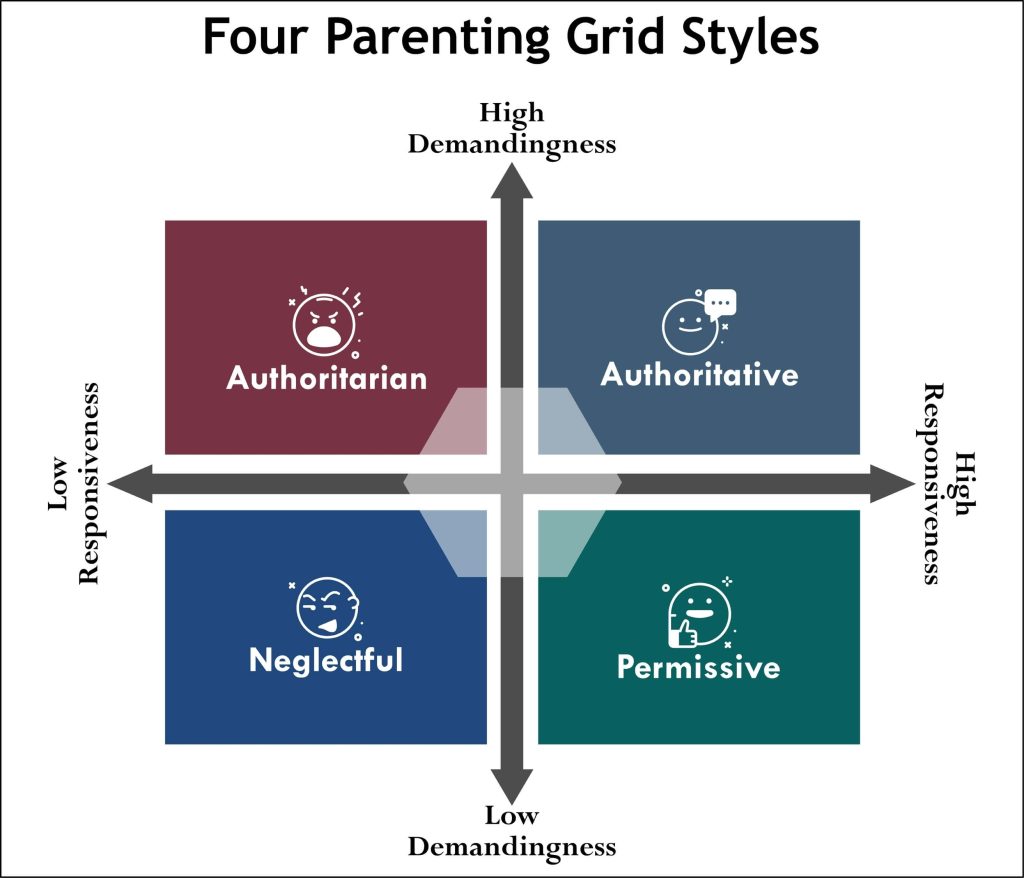
Parenting styles tend to be identified in terms of “control” and “responsiveness.”
- “Control”: the enforcement of rules to achieve desired behaviours
- “Responsiveness”: emotional connection
Authoritarian parenting is identifiable by high control and low responsiveness.
For the authoritarian parent, children’s behaviour is defined by how well they follow rules and conform to authority figures.
Successful parenting =
- The parent defines “good” behaviour
- The child demonstrates what has been defined for them
Commonly valued “good” behaviour:
→→→
| Characteristic | Expected outcome |
| Immediate obedience | The child complies quickly without questioning or negotiation |
| Rule adherence | Rules are followed consistently |
| Respect for authority | Adults’ instructions are accepted as final and non-negotiable |
| Low defiance | Arguing is unacceptable |
⠀
Research suggests that while these behaviours may appear positive, they are often rooted in fear. Some authoritarian households may administer harsh punishments, and even go as far as to employ corporal punishment if a child breaks the rules.
Parenting Styles & Associated Outcomes
Skyline Graphics / Shutterstock.com
In the 1960s, developmental psychologist Diana Baumrind identified three main parenting styles: authoritarian parents, authoritative, and permissive.
Baumrind watched families in real-life settings, noting instances of discipline, communication, warmth, and control. She also carried out interviews, parent questionnaires, and used teacher reports to inform her study.
The kids were assessed on social competence, independence, self-control, and emotional maturity.
Baumrind discovered consistent links; primarily, children of authoritarian parents adhere to strict obedience, possess poor autonomy, and suffer from low self-esteem, by comparison authoritative parenting, which has a lot of similar attributes, is linked to higher self-esteem, critical thinking, and self-regulation.
Authoritarian vs Other Parenting Styles
→→→
The table below highlights the core distinctions in how structure and emotional responsiveness interact across the four styles.
| Parenting Style | Warmth & Responsiveness | Control & Expectations | Typical Child Outcomes (Tendencies) |
| Authoritarian | Low warmth | High control, rigid rules | Obedience, low autonomy, anxiety, emotional suppression |
| Authoritative | High warmth | High expectations with guidance | Confidence, self-regulation, social competence |
| Permissive | High warmth | Low structure & limits | Creativity, impulsivity, difficulty with responsibility |
| Neglectful | Low warmth | Low involvement & guidance | Early independence, mistrust, emotional detachment |
Authoritarian
Authoritarian parents tend to demand obedience and rely on punishment, while withholding affection. They set clear boundaries and have consistently high expectations, and exercise harsh discipline. This approach often produces compliant behaviour in early childhood, but children may struggle with autonomy, self-confidence, and emotional expression, resulting in a tendency towards aggressive behaviour.
→→→
| Potential strengths | Common challenges |
| Strong rule-following and obedience | Low confidence in independent decision-making |
| Ability to function well in structured environments | Lower self-esteem and fear of failure |
| Awareness of expectations and authority | Difficulty expressing emotions or asserting needs |
| High behavioral compliance | Anxiety, perfectionism, and stress |
| Predictable behavior in supervised settings | Resentment or rebellion when control is removed |
Authoritative
Authoritative parents also have high expectations. Authoritative parents listen, they engage in setting clear boundaries while maintaining warmth and responsiveness, using explanation and consistency to guide child behaviour, which supports the child’s independence, emotional regulation, and long-term social abilities.
High responsiveness associated with authoritative parents is linked to stronger self-esteem, and better social skills, because children feel supported, understood, and safe expressing themselves.
→→→
| Potential strengths | Common challenges |
| Strong self-confidence and sense of autonomy | Discomfort in highly chaotic or inconsistent environments |
| Healthy independence with respect for boundaries | May question authority in rigid systems |
| Good emotional awareness and communication | High personal standards can lead to self-pressure |
| Internal motivation and balanced achievement | |
| Secure relationships and adaptive coping skills |
Permissive
Permissive parents emphasise warmth and acceptance but provide minimal structure and very few rules, allowing freedom that can encourage creativity, yet often at the expense of self-discipline and responsible decision-making.
Children often develop strong emotional expressiveness and openness, but may struggle with limits, routine, and long-term goal-setting.
→→→
| Potential strengths | Common challenges |
| High emotional expressiveness | Weak self-discipline |
| Creativity and openness | Difficulty with boundaries and rules |
| Strong relational warmth | Impulsivity and poor follow-through |
| Comfort sharing feelings | Trouble managing responsibilities |
| Flexible thinking | Frustration with authority or limits |
Neglectful
In 1983, Eleanor Maccoby and John Martin expanded on Baumrind’s findings, with the addition of a fourth style: neglectful. Children raised by neglectful parents are emotionally detached and used to inconsistent care and affection. This approach will most likely be detrimental to child psychology.
Adults raised with uninvolved parents are more resilient and independent, but avoid intimate relationships, mistrust others, exhibit anti-social behaviour, and suffer from poor mental health. Their independence tends to develop as a coping strategy rather than a supported skill.
→→→
| Potential strengths | Common challenges |
| Early self-reliance | Emotional detachment or avoidance |
| Adaptability in adverse conditions | Difficulty trusting others |
| Independence | Poor emotional regulation |
| Survival skills | Higher risk of mental health difficulties |
| Social isolation and relationship challenges |
Common Misconceptions
While authoritarian parents and authoritative parents may both enforce rules, the perceived parenting style differs significantly, particularly in how warmth and intent are communicated.
The principles of authoritarian parenting and authoritative parenting are often confused, as both can be characterised by high expectations of “good” behaviour. A key distinction between authoritarian and authoritative parents is how those expectations are addressed.
Children of authoritarian parents experience rigidity and punishment to force the child’s “good” behaviour.
For the authoritative parent, their perceived “good” behaviour is also important. However, the authoritative parent combines clear expectations with warmth, explanation, and responsiveness, encouraging the child to develop autonomy and emotional intelligence to guide themselves towards the parents’ valued outcome.
What Causes the Authoritarian Parenting Style
Research suggests that many parents tend to reproduce the parenting patterns they experienced in their own childhood—especially when it comes to discipline, emotional climate, and expectations. This phenomenon is often described as the intergenerational transmission of parenting styles. Studies show that behaviours such as strict control, punitive discipline, and low emotional responsiveness are more likely to be passed down from one generation to the next.
In other words, even when parents don’t consciously intend to be strict or emotionally distant, they may still default to familiar models they observed growing up. Parenting is often guided not only by beliefs and values, but also by deeply internalised experiences of what “normal” family life looks like.
Other common factors that contribute to the development of an authoritarian parenting style include:
- Cultural or generational norms about “strong parenting.” In many Western households of the late 20th century, strictness and “tough love” were framed as essential for building character, responsibility, or resilience. These narratives continue to shape parenting attitudes today.
- Stress, insecurity, and limited emotional resources. Research indicates that economic stress, social pressure, or burnout can increase reliance on rigid rules and controlling behaviours, simply because they feel like the fastest way to maintain order in the home.
- Belief that obedience equals safety or future success. Some parents adopt authoritarian approaches out of care and concern—wanting to protect their child from mistakes, risks, or failure, and assuming strict control will help them thrive.
Because of these influences, many modern parents—especially Western millennials now raising children—may still lean, often unintentionally, toward more authoritarian tendencies. This doesn’t mean they fully replicate their parents’ style; in fact, many strive to be warmer, more emotionally available, and more reflective. But those early internal models can subtly shape day-to-day reactions, especially in moments of stress, conflict, or fatigue.
Recognising where these patterns come from is an important first step. Once parents become aware that some behaviours are inherited rather than consciously chosen, it becomes easier to pause, reconsider automatic responses, and move toward a more authoritative, balanced, and responsive approach.
The Impact of Authoritarian Parenting on Children

FAMILY STOCK/Shutterstock.com
Children of authoritarian parents often learn to comply out of fear rather than understanding. What appear to be positive outcomes of authoritarian parenting are more often the consequence of the child’s need to avoid disappointing/defying authority and the fear of harsh punishment.
Those who experienced authoritarian parents in early childhood tend to be more likely to struggle with mental health, have low self-esteem, and indulge in risky behaviours.
In adolescence and adulthood, the impact often extends to reduced autonomy, weaker decision-making confidence, youth depression, and continued sensitivity to authority, as well as challenges with emotional intimacy and motivation, and other mental health challenges.
“Higher levels of authoritarian parenting have been associated with children’s increased electrocortical response to errors (the error-related negativity; Meyer et al., 2014)… These particular markers of electrocortical activity are clinically relevant because they are indicators of risk for anxiety and depression, respectively (Bress et al., 2013; Proudfit et al., 2013; Meyer et al., 2015)…
⠀
Furthermore, authoritarian parenting has been found to predict depression (Garber et al., 1997) and anxiety (Wolfradt et al., 2003) in adolescents.” (Levinson et al., 2017).
Although authoritarian parenting can manage behaviour in the short term, it does so at the cost of emotional well-being, self-regulation, and long-term resilience. Raising children on strict rules and threats of physical punishment associated with the authoritarian parenting style has been proven to negatively impact psychological development and lead to hostile attribution bias.
Research suggests hostile attribution bias can develop when children are frequently exposed to harsh discipline, rigid control, or unpredictable punishment, as they learn to stay hyper-alert to threat and authority. Over time, this can interfere with relationships, emotional regulation, and conflict resolution, because their instinct is to assume the worst.
When Authoritarian Parenting Shows Mixed Results
Authoritarian parenting often leads to high compliance and rule-following, especially in structured settings such as a school classroom. It can therefore be interpreted as resulting in positive behaviour. Especially where academic success is prioritised over emotional development.
While the negative impact of authoritarian parenting has been consistently demonstrated, these effects have not always been found in studies focused on subjects of Asian heritage. Differences in outcomes may reflect variation in perceived parenting style, as children interpret control and discipline differently depending on cultural norms and expectations.
For some ethnic groups, strict rules are more likely to be interpreted by children as care, responsibility, or moral guidance, rather than rejection. These cultures can produce children with strong education as well as respect for authority, while also being able to demonstrate emotional intelligence.
In the mid 90s, Ruth K. Chao led a study into asian adolescent school performance. Her research, published in Child Development, focused on the association between Chinese and Chinese-American adolescents’ education and parental control, similar to that demonstrated by authoritarian parents.
Chao found that what Baumrind identified as authoritarian parenting, low responsiveness, and lack of warmth, doesn’t account for cultural nuances. She argued that standard parenting measures failed to capture the concept of guan, the asian teachings of responsibility and moral guidance, which externally can appear like authoritarian parenting.
Her work challenged the assumption that authoritarian parenting produces universally negative outcomes and sparked a major debate about cultural bias in parenting research. Chao did not claim authoritarian parenting was ideal or harmless, only that Western definitions and measurement tools failed to account for the rest of the world.
However, although authoritarian parenting has been linked to academic success among Asian adolescents, large comparative studies do not support this claim.
Pong, Johnston, and Chen (2010) found that authoritarian parenting was not positively associated with education in Asian cultures, while authoritative parenting showed more consistent benefits.
The study is frequently misused to reinforce the notion that authoritarian parenting works for Asians, when in fact the authors explicitly challenge the idea that authoritarian parenting explains higher academic performance among Asian adolescents, calling that conclusion overstated and methodologically flawed.
The authors compared adolescents of English-speaking American families in the USA with adolescents raised in Taiwan. They discovered, contrary to popular belief, that authoritarian parenting was not positively associated with academic achievements in Taiwan. In some analyses, the association was neutral or negative.
Authoritative parenting showed more consistent positive associations with academic performance, even in cultural contexts where strict parenting is more common.
How to Recognise if You’re Authoritarian Parents

Nicoleta Ionescu / Shutterstock.com
Many of the characteristics associated with authoritarian parenting, such as structure, consistency, and clear expectations, can contribute to raising a well-rounded individual. However, when these traits are paired with low emotional responsiveness, they can lead to negative outcomes in the child’s life, including low self-esteem and poor mental health.
Studies in child psychology confirm that children raised by authoritarian parents tend to demonstrate aggressive behaviours. Tick the statements you agree with:
Autonomy
- You expect immediate obedience
- Phrases like “Because I said so” are common in your responses
- You rarely ask for your children’s opinions
- You interpret questioning rules as disrespectful
Obedience
- You don’t feel it’s necessary to explain rules
- You view flexibility as a weakness
- You value compliance over comprehension
- You discourage curiosity
Discipline
- You’re quicker to threaten punishment than teach problem-solving
- Consequences are primarily meant to deter behaviour, not explain it
- You end up shouting more often than not
- You praise obedience more than effort
Emotional Intelligence
- You limit affection or empathy during conflict
- Children are told off for strong emotional reactions
- You think showing warmth will undermine your authority
- Emotional needs are only addressed after behaviour is corrected
Worries
- You worry that being understanding will make you seem like a pushover
- You feel responsible for controlling outcomes rather than guiding skills
- You were raised with strict discipline and find it difficult to do anything else
- You don’t want your children to end up like you
How to Interpret Your Results
- 0–3: Occasional control-based responses (common under stress)
- 4–7: Mixed approach; authoritarian techniques may surface in pressure situations
- 8+: Authoritarian patterns likely influencing daily interactions
Important Reminder
Authoritarian techniques often appearduring stress, fear, or burnout, not from lack of care. Awareness is the first step toward adjusting the approach without losing structure or authority.
How to Adjust if You’re an Authoritarian Parent: Practical Alternatives & Balanced Parenting
First, the not-so-good news—if you scored highly, you might be adopting a little more of the authoritarian style in your parenting, which might end up with some negative repercussions in the long run.
Good news—being raised in a particular environment does not predetermine the future, and no learned behaviour is irreversible or unadaptable.
Lived experiences, like education, supportive relationships, therapy, or exposure to alternative models of parenting, can influence many people raised by authoritarian parents to adopt different parenting styles from their own.
There are plenty of techniques you can consider pto adjust to a more authoritative model.
Communication Vs Obedience
Authoritative parents explain why rules exist to help the child appreciate them rather than blindly following less fear of corporal punishment. Guidance and emotional support in early childhood help to mould child’s behaviour. High expectations are still imposed, but higher self-esteem is also nurtured through autonomy.
Example:
Charlie doesn’t want to brush their teeth.
Dialogue:
- Charlie: I don’t want to brush my teeth.
- Charlie’s parents: Brush your teeth, or you don’t get a bedtime story.
The focus is on compliance and punishment, as opposed to understanding. Charlie is resentful of the parental control, but doesn’t want to endure the punishment, so they reluctantly comply.
Charlie’s reaction to the rule can be reframed by implementing a more authoritative approach.
Reframed dialogue:
- Charlie: I don’t want to brush my teeth.
- Charlie’s parents: Looking after your teeth is very important. Tiny bits of food and germs stick to our teeth, and if we leave them there, they go all yucky, they make our mouth smelly, and they can even make little holes called cavities, which can be very sore. That’s why we clean our teeth in the morning and at night.
Charlie is given agency. Not following the rule will result in what they now perceive as logical consequences, but Charlie can make an informed decision as to whether they follow it. They can balance the pros and cons internally, building their emotional intelligence, understanding cause and effect, and contributing toward higher self-esteem.
Punishment vs Consequences
When a rule is broken, focus on explaining the outcome, rather than enforcing a punishment. Authoritative parents lead children towards what they deem to be good decision-making.
Example:
Rea leaves their shoes in the middle of the hallway.
Dialogue:
- Rea’s parents: Put your shoes away, or there’s no dessert.
Reframed dialogue:
- Rea’s parents: We put our shoes away so we know where they are in the morning when we want to put them on. If you leave them in the middle of the hall, someone might trip over them and hurt themselves.
Rea understands why the rule exists. They appreciate the consequence of not adhering to the rule.
Negotiation Vs Compliance
Rules are made to be broken. It’s important to be flexible sometimes. Authoritative parents listen to the child’s opinions makes them feel involved in decision-making and developing their sense of autonomy. If they’ve played a part in engineering a rule, they are more likely to comply with it than endure the natural consequences.
Example:
Nat doesn’t want to do their chores.
Dialogue:
- Parent: That’s enough screen time for today. You need to do your chores.
- Nat: Just one more episode?
- Parent: No. Put it away, or you won’t have any screen time tomorrow.
Reframed dialogue:
- Parent: That’s enough screen time for today.
- Nat: Just one more episode?
- Parent: How long is the episode?
- Nat: 20 minutes.
- Parent: How about you can have another 10 minutes for each of your chores you get done first?
as identified by Erik H. Erikson, by early adolescence, children are more likely to identify with parents who use reason rather than force to justify their decisions and demands.
Fair Vs Unfair
“It’s not fair” — every child’s mantra. Instead of forcing a behaviour through punishment they deem unfair, enquire why they see it that way and explain how else they might look at it. Opening a dialogue about fairness and why rules exist teaches them to recognise when something can feel unfair; there is usually a balanced and reasonable explanation for it.
Example:
Teddy doesn’t want to have a shower.
Dialogue:
- Parent: Teddy, come on, it’s time to have a shower now.
- Teddy: But I’m playing. It’s not fair.
- Parent: Get in the shower, or I’ll take the toy away.
Reframed dialogue:
- Parent: Teddy, come on, it’s time to have a shower now.
- Teddy: But I’m playing. It’s not fair.
- Parent: Tell me why it’s not fair?
- Teddy: Because I’m playing.
- Parent: You can go back to playing after your shower.
- Teddy: But it’s not fair.
- Parent: Would it be very fair to your classmates tomorrow if you go to school smelly because you haven’t had a wash?
This reframing of the narrative encourages the child to internalise learning and supports their emotional development.
Common Challenges and Mistakes — and How to Avoid Them

Nicoleta Ionescu / Shutterstock.com
Moving from an authoritarian approach to a more authoritative style doesn’t mean relinquishing all control and removing all of your carefully considered and honed household rules and procedures. It’s about tweaking how the rules are framed from the child’s perspective.
Five Common Mistakes
Here are four common challenges and mistakes parents make when changing their parenting style from authoritarian to authoritative parenting:
- Confusing authority with control.
- Straying too close to permissiveness.
- Inconsistent implementation.
- Expecting immediate results.
- Neglecting to fix emotional cracks.
How to Reframe Your Authoritarian Mindset
It’s impossible to seamlessly adopt a more authoritative parenting style. There will be slip-ups and transgressions along the way. But well done for starting to consider changing. Here are some important reminders to consider to avoid mistakes:
- You are the authority figure, not the puppet master. You cannot control a child. You can only guide them. Authoritative parenting is about instilling values and giving them the tools to grow and make good life choices, whilst being aware of boundaries and appropriate consequences.
- It’s easy to think you need to throw away all of your values and start again. That’s not true. You’re doing great, you just need a few changes. You don’t need to flick a switch and let them go feral.
- You’re stressed, tired and at the end of your tether—breath. What would you say to your child if they were on the verge of a meltdown? That is now your mantra. Times of extreme emotion can easily lead to regression. Don’t slip back into harsh parenting and punishments; keep things consistent.
- Long-term change takes time. You are both learning new techniques. Rome wasn’t built in a day.
- Focus on building, not blaming. If kids do something wrong, how can they fix it? Teach them, talk to them, help them to understand you are there to protect and love them, encourage them to own their mistakes and correct their behaviour for themselves, not for you.
Is It Time to Rethink Your Parenting Style?
Have you spotted any negative techniques you might want to get rid of? Rethinking a parenting style does not mean abandoning the structure you have already built.
Sofie Kuppens and Eva Ceulemans summarise the pros and cons of authoritarian and authoritative parenting styles, in their article Parenting Styles: A Closer Look at a Well-Known Concept (J Child Fam Stud 2019):
“An appropriate amount of behavioral control has been considered to positively affect child development, whereas insufficient (e.g., poor parental monitoring) or excessive behavioral control (e.g., parental physical punishment) has been commonly associated with negative child developmental outcomes, such as deviant behavior, misconduct, depression and anxious affect (e.g., Barnes and Farrell 1992; Coie and Dodge 1998; Galambos et al. 2003; Patterson et al. 1984).”
Research suggests authoritative parenting is associated with the most beneficial outcomes across emotional, social, and academic domains. Authoritarian and authoritative parenting share a lot of similarities, so you’re already halfway there.
FAQs
What does authoritarian parenting do to a child?
Children raised by authoritarian parents tend exhibit poor self-esteem, anxiety, reduced autonomy, and difficulty expressing emotions. Children may comply to avoid punishment but lack the understanding of core values, which can lead to negative emotions and behaviours.
What is an example of authoritarian parenting?
Authoritarian parents often lack an emotional connection and see no value in children’s opinions. An authoritarian parent forces children’s behaviour without explanation, such as demanding obedience, “because I said so.”
Do authoritarian parents yell?
Yelling as a form of punishment is not exclusive to parents practising the authoritarian style, but when control and compliance are prioritised, raised voices are more common.
What is the most effective parenting style?
Clinical child research suggests the authoritative approach is the most effective of the four major parenting styles. Authoritative parenting is associated with the most beneficial outcomes across emotional, social, and academic domains. The child’s cognitive development is supported and reinforced with a consistent balance of boundaries, explanations, warmth, and building autonomy.
Resources
- Intergenerational transmission of harsh parenting, Simons, R. L., Whitbeck, L. B., Conger, R. D., & Wu, C-I., American Psychological Association, 1991
- Type-specific intergenerational transmission of neglectful and physically abusive parenting behaviors among young parents, Pears, K. C., & Capaldi, D. M., ScienceDirect, 2001
- The Transmission of Parenting Behaviour Within the Family: An Empirical Study Across Three Generations, Putallaz, M., et al., Psychologica Belgica, 1998
- The association between parenting and the error-related negativity across childhood and adolescence, Bress, J., Hajcak, G.; Proudfit, G. H.; Meyer, A. et al., NCBI, 2013; 2015
- Beyond parental control and authoritarian parenting style: Understanding Chinese parenting through the cultural notion of training,Chao, R. K., Ovid, 1994
- Parenting Styles: A Closer Look at a Well-Known Concept, Sofie Kuppens & Eva Ceulemans, Journal of Child and Family Studies, 2019
- Peer rejection and hostile attributional bias in childhood, Dodge, K. A., & Hoza, B. The Development of Social Cognition, 1997
- An integrated model of emotion processes and cognition in social information processing, Lemerise, E. A., & Arsenio, W. F. Child Development, 2003
- Authoritarian parenting attitudes and social origin: The multigenerational relationship of socioeconomic position to childrearing values, Michael Friedson. Child Abuse & Neglect 2016
- Physical punishment and child outcomes: a narrative review of prospective studies, Anja Heilmann, Anita Mehay, Richard G Watt, Yvonne Kelly, Joan E Durrant , Jillian van Turnhout, Elizabeth T Gershoff. Lancet, 2022
- Authoritarian Parenting and Asian Adolescent School Performance: Insights from the US and Taiwan, Suet-ling Pong, Jamie Johnston, and Vivien Chen. International Journal of Behavioral Development, 2009
- Authoritarian parenting predicts reduced electrocortical response to observed adolescent offspring rewards, Amanda R. Levinson , Brittany C. Speed , Brady Nelson , Jennifer N. Bress , Greg Hajcak. Social Cognitive and Affective Neuroscience, 2017
- Handbook of Moral Development, Melanie Killen, Judieth G. Smetana, 2013
- Identity and the life cycle, Erik H Erikson, 1959
Cover image: Yeexin Richelle / Shutterstock.com
Проверьте электронный ящик