














If you’ve ever watched your kid stomp off, slam a door, or hide under a blanket, then totally clam up when asked, “What’s wrong?” then that’s where emotion words and feeling words can jump in to save the day.
But what, exactly, do we mean by that? That’s what this guide is for. It’s your toolkit for helping kids put actual names to all those swirling, intense feelings. We’ll cover the best words, quick tips for teaching them, and fun activities so your kids (and maybe you!) can finally talk about what’s been bugging them.
Contents:
- What Are Emotion Words?
- Emotions vs. Feelings vs. Moods
- Core Emotion Frameworks: How to Break It Down
- What Is Emotional Intelligence
- The Feelings Word List
- Emotion Recognition: How to Identify and Name Feelings
- How to Teach Emotion Words at Home
- When Kids Struggle to Express Their Feelings
- FAQs
What Are Emotion Words?
Emotion words are the simple vocabulary we use to describe our feelings, but don’t let “simple” fool you.
Though the words themselves are simple, the meaning is anything but. This lingo packs a massive punch for kids and teens.
Why? Because the difference between mumbling “I’m fine” and saying “I feel anxious and left out” can change the conversation (and the outcome) completely.
Kids who can explain their feelings with specific words aren’t just easier to talk to, but instead, are more likely to build deep friendships, perform well in school, and roll with life’s ups and downs.
You don’t have to take our word for it, either: children with strong emotional vocabularies tend to outperform peers in both academics and social relationships.
If a child can’t describe their feelings, those emotions come out in some other way: usually, meltdowns, moodiness, or shutting down. Handing a kid the right feeling words gives them options and a sense of control, meaning it’s the key difference between drowning in feelings and calmly riding the waves.
Emotions vs. Feelings vs. Moods
These three words sound super similar, but here’s how to keep them straight without needing a psych degree:
- Emotions are your body’s autopilot: the quick, instinctive reactions to stuff happening around you. Like when the dog barks and your heart jumps. Boom, that’s emotion.
- Feelings show up after your mind gets involved. That heartbeat? Now you’re thinking, “Whoa, I’m startled!” The sensation becomes a thought.
- Moods are the background music to your day. They usually last way longer than a single emotion or feeling, and sometimes you don’t even know why you’re in one. (Ever had a grumpy day for no apparent reason? Yup, that’s the mood.)
Core Emotion Frameworks: How to Break It Down
Even scientists understand that emotions and feelings are a tangled mess, so they’ve created models to organize everything. Here are some big ones you should know:
Shaver’s Emotion Hierarchy
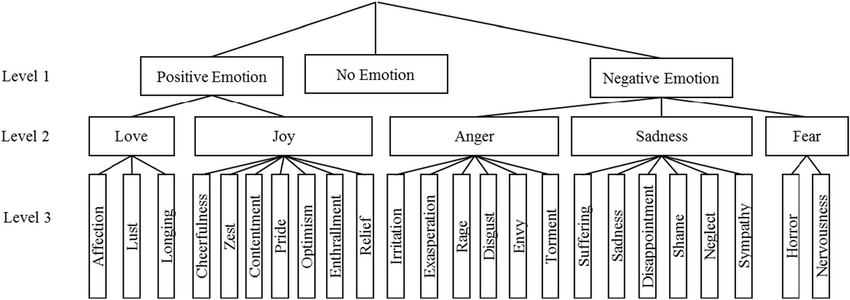
Emotion structure based on Shaver et al. (1987, p. 1067). Credit: researchgate.net
Start broad, then zoom in. Six primary emotions (love, joy, surprise, anger, sadness, and fear) branch into more precise words (like “rage” or “resentment” under anger), then even more refined words. It’s like a family tree for feelings.
Ekman’s Basic Emotions
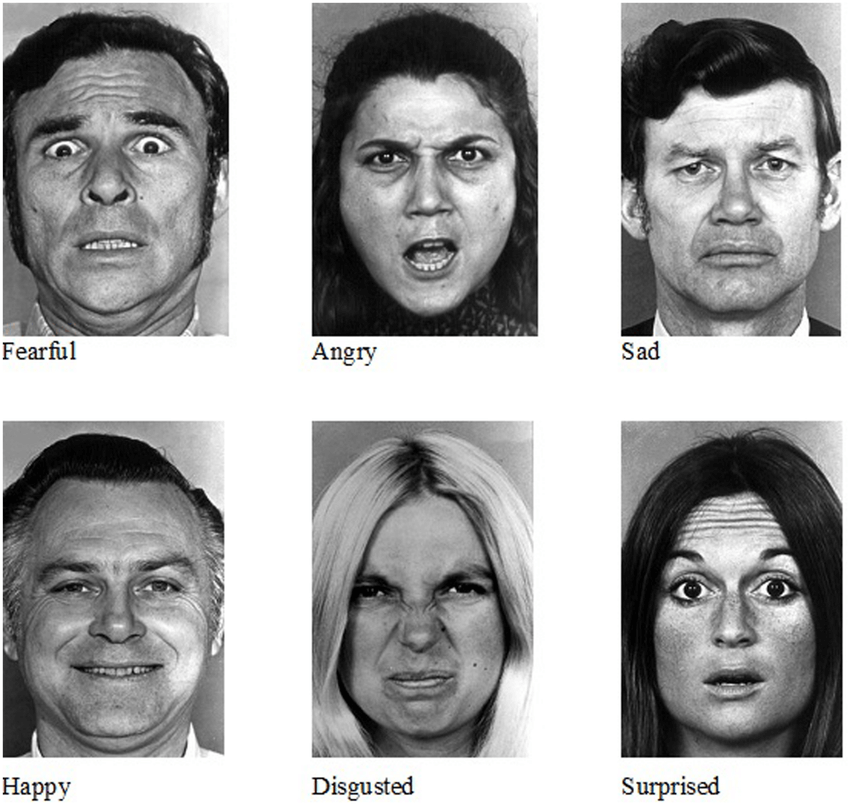
Ekman’s 6 basic emotions and corresponding facial expressions. Credit: researchgate.net
Paul Ekman (the guy behind all those “Lie to Me” TV shows) found six basics: happiness, sadness, fear, anger, surprise, and disgust. These are the building blocks for other feelings.
Plutchik’s Wheel
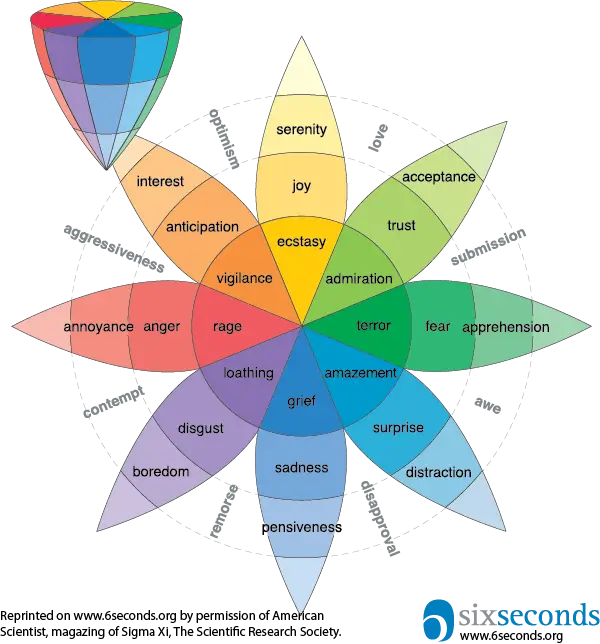
Credit: 6seconds.org
Picture a color wheel, but for feelings. Eight main emotions (joy, trust, fear, surprise, sadness, disgust, anger, anticipation), with combos that blend to make even more nuanced feelings. The closer you are to the center, the more intense the emotion (think “rage” instead of just “annoyed”).
What Is Emotional Intelligence
Emotional intelligence (EQ) is having a sixth sense for your own feelings and picking up on what others feel, too. And using emotion words is the secret sauce.
Research backs it up: Kids with higher EQ not only have better relationships, but they also cope with stress, study better, and are less likely to face depression and anxiety.
Here’s what strong EQ brings kids:
- Genuine, supportive friendships
- Fewer tantrums and less drama
- Better grades
- Improved resilience when stuff falls apart
- Lower anxiety and happier mental health
And it all starts with a good list of emotion words.
Read more: What is Emotional Intelligence and How to Bring Up a Happy Child?
The Feelings Word List
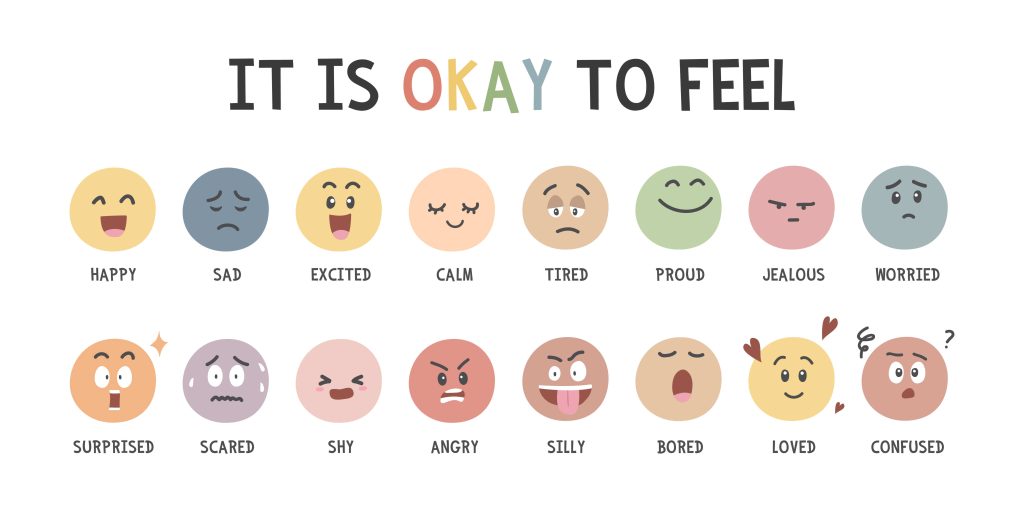
tqvinh9x / Freepik.com
If you’re looking for a cheat sheet to help you figure out where to start, we’ve got a checklist for you. Here’s a list of feeling words, sorted for easy reference. Print them out, stick them on the fridge, or use them next time your kid gets quiet (or enraged).
Anger Words
Not all anger is the same. A “grumpy” morning is different from a “furious” meltdown. Help kids pick the right anger word for their situation.
→→→
| Emotion family | Word | Simple meaning | Example sentence (kid-friendly) | Intensity |
| Anger | Aggravated | Feeling bothered again and again | “I feel aggravated when my sister keeps touching my stuff.” | Medium |
| Anger | Agitated | Restless and upset | “I’m agitated because I can’t sit still before the test.” | Medium |
| Anger | Annoyed | Slightly angry | “I’m annoyed that the game froze.” | Low |
| Anger | Bitter | Angry about something that feels unfair | “He felt bitter after losing even though he tried hard.” | Medium |
| Anger | Cranky | Grumpy and easily upset | “I’m cranky because I didn’t sleep well.” | Low |
| Anger | Cross | Mildly angry | “She was cross when her turn was skipped.” | Low |
| Anger | Disgusted | Strong dislike | “I’m disgusted by that smell!” | Medium |
| Anger | Enraged | Extremely angry | “He was enraged when someone broke his bike.” | High |
| Anger | Exasperated | Tired of being annoyed | “I’m exasperated explaining this again.” | Medium |
| Anger | Frustrated | Upset because something is hard | “I’m frustrated with this puzzle.” | Medium |
| Anger | Furious | Very, very angry | “She was furious when her project got ruined.” | High |
| Anger | Grumpy | In a bad mood | “I’m grumpy this morning.” | Low |
| Anger | Hostile | Mean and unfriendly | “He sounded hostile when he spoke.” | High |
| Anger | Impatient | Upset about waiting | “I’m impatient for my turn!” | Low |
| Anger | Indignant | Angry about unfairness | “I felt indignant when they blamed me.” | Medium |
| Anger | Irate | Extremely angry | “Dad was irate about the broken window.” | High |
| Anger | Irritated | Slightly bothered | “I’m irritated by the noise.” | Low |
| Anger | Jealous | Wanting what someone else has | “I felt jealous of her new shoes.” | Medium |
| Anger | Mad | Angry | “I’m mad that he lied.” | Medium |
| Anger | Outraged | Shocked and angry | “She was outraged by the rude comment.” | High |
| Anger | Resentment | Quiet anger held inside | “I felt resentment after being ignored.” | Medium |
| Anger | Spiteful | Wanting to hurt back | “He made a spiteful comment.” | High |
Fear and Anxiety Words
Fear keeps you safe from danger, but anxiety can sneak up and shadow you for days. Giving these feelings a name helps kids get a handle on them.
→→→
| Emotion family | Word | Simple meaning | Example sentence | Intensity |
| Fear | Afraid | Feeling scared | “I’m afraid of the dark.” | Medium |
| Fear | Anxious | Worried about what might happen | “I feel anxious before tests.” | Medium |
| Fear | Apprehensive | Nervous about something coming | “I’m apprehensive about meeting new kids.” | Medium |
| Fear | Concerned | Thinking something might be wrong | “I’m concerned about my friend.” | Low |
| Fear | Frightened | Suddenly scared | “I was frightened by the loud noise.” | Medium |
| Fear | Hesitant | Unsure and nervous | “I’m hesitant to jump in.” | Low |
| Fear | Nervous | Feeling shaky or uneasy | “I’m nervous before my speech.” | Low |
| Fear | Overwhelmed | Too much to handle | “I’m overwhelmed with homework.” | High |
| Fear | Panicked | Very scared suddenly | “I panicked when I lost my bag.” | High |
| Fear | Scared | Feeling afraid | “I’m scared of that dog.” | Medium |
| Fear | Stressed | Feeling pressured | “I’m stressed about school.” | Medium |
| Fear | Terrified | Extremely scared | “I was terrified in the storm.” | High |
| Fear | Timid | Shy and scared | “He’s timid in new places.” | Low |
| Fear | Uneasy | Slightly uncomfortable | “I feel uneasy here.” | Low |
| Fear | Vulnerable | Feeling unprotected | “I felt vulnerable being alone.” | Medium |
| Fear | Worried | Thinking about bad outcomes | “I’m worried about Mom.” | Medium |
Sadness and Grief Words
Sad, gloomy, or heartbroken…these all describe loss or disappointment. Kids often need several tries to settle on what’s really going on, so keep this list handy.
→→→
| Emotion family | Word | Simple meaning | Example sentence | Intensity |
| Sadness | Alone | Feeling without others | “I felt alone at recess.” | Medium |
| Sadness | Ashamed | Feeling bad about yourself | “I felt ashamed after lying.” | Medium |
| Sadness | Blue | A little sad | “I’m feeling blue today.” | Low |
| Sadness | Dejected | Feeling let down | “I felt dejected after losing.” | Medium |
| Sadness | Depressed | Very sad for a long time | “He felt depressed for weeks.” | High |
| Sadness | Despair | Feeling no hope | “She felt despair after the news.” | High |
| Sadness | Disappointed | Sad something didn’t happen | “I’m disappointed it rained.” | Low |
| Sadness | Discouraged | Losing confidence | “I felt discouraged after failing.” | Medium |
| Sadness | Empty | Feeling nothing inside | “I felt empty after moving.” | High |
| Sadness | Gloomy | Dark and sad mood | “It’s a gloomy day.” | Medium |
| Sadness | Grief | Deep sadness after loss | “She felt grief after her pet died.” | High |
| Sadness | Guilty | Feeling bad for doing wrong | “I feel guilty about yelling.” | Medium |
| Sadness | Heartbroken | Extremely sad | “He was heartbroken over his dog.” | High |
| Sadness | Hopeless | Feeling nothing will help | “I felt hopeless after trying again.” | High |
| Sadness | Hurt | Feeling emotional pain | “My feelings were hurt.” | Medium |
| Sadness | Lonely | Feeling without friends | “I feel lonely sometimes.” | Medium |
| Sadness | Melancholy | Quiet sadness | “She felt melancholy at sunset.” | Medium |
| Sadness | Mournful | Deep and quiet sadness | “He looked mournful.” | High |
| Sadness | Sad | Feeling unhappy | “I’m sad today.” | Low |
| Sadness | Sorrowful | Very sad | “She looked sorrowful.” | High |
| Sadness | Upset | Disturbed emotionally | “I’m upset about the fight.” | Medium |
Joy and Happiness Words
Celebrate the good times, too! It’s easy to forget to talk about positive feelings when life gets busy.
→→→
| Emotion family | Word | Simple meaning | Example sentence | Intensity |
| Joy | Amused | Finding something funny | “I’m amused by that joke.” | Low |
| Joy | Blissful | >Extremely happy | “I felt blissful at the beach.” | High |
| Joy | Brave | Feeling strong inside | “I was brave at the dentist.” | Medium |
| Joy | Calm | Peaceful and relaxed | “I feel calm now.” | Low |
| Joy | Cheerful | In a good mood | “She’s cheerful today!” | Medium |
| Joy | Confident | Believing in yourself | “I’m confident I can try.” | Medium |
| Joy | Content | Happily satisfied | “I feel content here.” | Low |
| Joy | Delighted | Very pleased | “I’m delighted with my gift.” | Medium |
| Joy | Ecstatic | Extremely excited | “I’m ecstatic about the trip!” | High |
| Joy | Elated | Very joyful | “She felt elated after winning.” | High |
| Joy | Enthusiastic | Very interested | “I’m enthusiastic about art!” | Medium |
| Joy | Excited | Happy and eager | “I’m excited for my party!” | Medium |
| Joy | Glad | Happy something happened | “I’m glad you came.” | Low |
| Joy | Happy | Feeling good | “I’m happy today.” | Low |
| Joy | Hopeful | Believing good will happen | “I’m hopeful for tomorrow.” | Medium |
| Joy | Joyful | Full of joy | “He looked joyful.” | Medium |
| Joy | Jubilant | Celebrating happily | “We were jubilant after winning!” | High |
| Joy | Optimistic | Expecting good things | “I’m optimistic about school.” | Medium |
| Joy | Pleased | Feeling satisfied | “I’m pleased with my work.” | Low |
| Joy | Proud | Happy about the achievement | “I’m proud of myself!” | Medium |
| Joy | Relieved | Happy stress is gone | “I’m relieved it’s over.” | Medium |
| Joy | Satisfied | Feeling enough | “I’m satisfied with that.” | Low |
| Joy | Thrilled | Very excited | “I’m thrilled about the trip!” | High |
Love and Connection Words
We’re wired for connection, and these words help kids talk about belonging, kindness, and acceptance.
→→→
| Emotion family | Word | Simple meaning | Example sentence | Intensity |
| Love | Accepted | Feeling welcomed | “I feel accepted here.” | Medium |
| Love | Affectionate | Showing love | “She gave me an affectionate hug.” | Medium |
| Love | Appreciated | Feeling valued | “I feel appreciated.” | Medium |
| Love | Attached | Feeling close | “I’m attached to my teddy.” | Medium |
| Love | Caring | Wanting to help | “She’s very caring.” | Medium |
| Love | Close | Emotionally near | “We’re close friends.” | Medium |
| Love | Compassionate | Feeling for others | “He’s compassionate.” | Medium |
| Love | Connected | Feeling linked | “I feel connected to my team.” | Medium |
| Love | Dedicated | Strongly committed | “She’s dedicated to dance.” | High |
| Love | Devoted | Deeply loyal | “He’s devoted to his dog.” | High |
| Love | Empathetic | Understanding feelings | “She’s empathetic.” | Medium |
| Love | Friendly | Kind and open | “He’s friendly to everyone.” | Low |
| Love | Лind | Gentle and helpful | “She’s kind to me.” | Low |
| Love | Love | Strong care | “I love my family.” | High |
| Love | Peaceful | Calm and safe | “I feel peaceful here.” | Low |
| Love | Safe | Feeling protected | “I feel safe at home.” | Medium |
| Love | Secure | Feeling stable | “I feel secure with you.” | Medium |
| Love | Supported | Feeling helped | “I feel supported.” | Medium |
| Love | Thankful | Feeling grateful | “I’m thankful for you.” | Low |
| Love | Trusting | Believing in others | “I’m trusting you.” | Medium |
Surprise and Interest Words
Not all surprises are fun, but every surprise grabs attention. These words work for both good and not-so-good moments.
→→→
| Emotion family | Word | Simple meaning | Example sentence | Intensity |
| Surprise | Amazed | Very impressed | “I’m amazed by that trick!” | Medium |
| Surprise | Astonished | Shocked in a good way | “I was astonished!” | High |
| Surprise | Awed | Filled with wonder | “I was awed by the stars.” | Medium |
| Surprise | Baffled | Confused | “I’m baffled by this.” | Medium |
| Surprise | Confused | Not understanding | “I’m confused about that.” | Low |
| Surprise | Curious | Wanting to know more | “I’m curious about space.” | Low |
| Surprise | Eager | Excited to start | “I’m eager to try!” | Medium |
| Surprise | Engaged | Focused and interested | “I’m engaged in class.” | Medium |
| Surprise | Engrossed | Deeply interested | “I’m engrossed in this book.” | Medium |
| Surprise | Fascinated | Very interested | “I’m fascinated by dinosaurs.” | High |
| Surprise | Inspired | Wanting to create | “I’m inspired to draw!” | Medium |
| Surprise | Intrigued | Curious and interested | “I’m intrigued by that.” | Medium |
| Surprise | Jolted | Suddenly surprised | “I was jolted awake.” | Medium |
| Surprise | Moved | Emotionally touched | “That story moved me.” | Medium |
| Surprise | Puzzled | Slightly confused | “I’m puzzled by that.” | Low |
| Surprise | Shocked | Strong surprise | “I was shocked!” | High |
| Surprise | Speechless | No words | “I was speechless!” | High |
| Surprise | Startled | Suddenly surprised | “I was startled by noise.” | Medium |
| Surprise | Stunned | Very shocked | “I was stunned by the news.” | High |
| Surprise | Touched | Warmly affected | “I was touched by that.” | Medium |
Emotion Recognition: How to Identify and Name Feelings
Recognition is step one in mastering emotions. Get kids to “check in” with their bodies and minds:
- Ask, “What’s your stomach or chest telling you right now?”
- Say, “You look tense. What’s going on in your mind?”
- Connect the dots: fast heartbeat? Sweaty hands? That might be anxiety showing up.
Encourage kids to identify not just the easy stuff (happy, mad), but also the trickier feelings like resentment or disappointment. The more precise the word, the clearer the feeling becomes.
A few tips that really help at this stage:
- Slow the moment down. Big emotions often come and go fast. Teach kids to pause for a few seconds and ask themselves, “What am I feeling right now?” This tiny pause already builds emotional awareness.
- Separate feelings from behavior. Help kids see that emotions themselves are never “bad” — only actions can be unsafe or unkind. A child can feel furious and still choose not to hit. This distinction reduces shame and makes naming feelings safer.
- Offer options, not quizzes. Instead of “Why are you upset?”, try “Are you feeling more angry or more disappointed?” This supports kids who don’t yet have the words and prevents the conversation from feeling like an interrogation.
- Use everyday moments, not only crises. Emotion recognition works best when practiced during calm, neutral situations—in the car, after school, while cooking—not only during meltdowns. This builds the skill before it’s urgently needed.
- Normalize mixed feelings. Kids often think they must feel just one thing at a time. Show them it’s okay to feel excited and nervous, proud and scared. This makes emotional life feel richer and more understandable.
The goal isn’t to fix everything at once, but instead, to give kids the power to pause, notice, and name what’s happening inside—so emotions stop being something mysterious or overwhelming and start becoming something they can understand and talk about.
Helping kids recognize and name their feelings is important, but consistent support is even more effective when paired with the right tools. The Findmykids app can provide parents with insights into children’s daily routines, app usage, and behavior patterns. By using these tools, you can better understand when your child may be feeling stressed, overwhelmed, or withdrawn—and respond with care. Start using Findmykids today to stay connected and help your child navigate their emotions safely and confidently.
How to Teach Emotion Words at Home

yanalya / Freepik.com
With the list of emotion words hooked to your fridge, it’s time for action! Here’s how you weave emotion words into your daily life, with no extra stress required.
Narrate Your Own Feelings
Let your kids “catch” you using feeling words. “I’m frustrated that the WiFi crashed,” or “I feel happy when we eat pizza together.” It normalizes naming feelings.
Talk About Characters
Whether it’s bedtime books or Friday night movies, pause and ask, “How do you think that character feels right now?” Get specific with the words. Have your child make a guess, then ask what clues gave it away (tears, a red face, laughter, etc.).
Acknowledge, Don’t Minimize
When your kid’s angry about sharing the last cookie, saying “You sound disappointed!” goes further than “It’s not a big deal.” Help kids feel seen and learn the right word for what’s bugging them.
Feelings Poster
Let your child help create a poster with faces and words from the list above. Reference it often, especially when emotions are tricky to describe.
Play Games and Activities to Practice Emotion Words
Turn building emotional vocab into a fun family ritual:
- Feelings Charades: Kids pull a feeling word from a bowl and act it out (no words!), while the rest of the family guesses. It builds empathy and helps everyone recognize expression clues.
- Emotion Word of the Day: Stick a new emotion word on the fridge each morning. Challenge everyone to use it at least once. You’ll be surprised how quickly the vocabulary grows!
- Story Switch-Up: Take turns adding sentences to a story where the characters’ feelings change with each twist. Try, “Once there was a kid who felt furious. Then her friend shared a snack, and she felt relieved.” This invites creativity and keeps the discussion playful.
When Kids Struggle to Express Their Feelings
Everyone hits a wall sometimes with feelings. Kids, adults, you name it. If your child shuts down or only gets angry or sad without explaining, don’t panic. Often, it’s a mix of “don’t know how” and “not comfortable yet.”
Offer different options: ask them to draw out their anger or emotional pain, write down feelings, or act out a scene with toys or puppets.
Sometimes, kids can comment on how a character feels when they’re too shy to describe their own feelings directly. And while it’s tempting to push, just being a calm, reliable presence works wonders.
Notice patterns, too. If your student keeps holding in emotion or struggles to comment on it, loop in a counselor or therapist for continuing support.
Give Kids the Words. They’ll Build Their Emotional Toolkit
Words matter. When you help your kids expand their list of emotion words, you’re making life easier for everyone: at home, at school, and out in the world. Better communication brings less drama and more connection, and it makes kids more comfortable and confident facing whatever the day throws at them.
Keep building, keep playing, and keep showing your child that their feelings and words matter.
English is a wild language with so many great ways to describe what’s on your mind, so keep the conversation going as your kids keep growing!
FAQs
What are emotion words?
Emotion words (also called feeling words) are vocabulary terms for our inner experiences: happy, sad, angry, anxious, and beyond. These words help kids, students, and even adults name and better understand what’s going on emotionally.
What’s the difference between emotions and feelings?
Emotions are your automatic body reactions (like a fast heartbeat from fear or anger). Feelings kick in when your mind labels those body experiences. It’s a two-step process: something happens (emotion), then you interpret it (feeling).
What are common feeling words for kids?
Classic feeling words for kids: happy, sad, mad, scared, excited, surprised. As they grow, add depth with words like proud, nervous, frustrated, lonely, or disappointed.
How do I teach my child to express feelings with words?
Model it daily! Share your own feelings using clear words, talk about book or movie characters, ask your child for a “feelings check-in,” and use engaging activities or games (like charades or word-of-the-day). The more comfortable everyone feels naming emotions, the quicker kids pick it up.
What are examples of emotional pain words?
Words for emotional pain include devastated, heartbroken, worthless, humiliated, and despair. These go deeper than words like “sad”. They get at the root of emotional discomfort and suffering.
How can I expand my emotional vocabulary fast?
Google gives a ton of lists (including the one in this article!). The more you use new words, the quicker they’ll stick.
Cover image: freepik / Freepik.com
Проверьте электронный ящик