

















Authoritative parenting is too often confused with authoritarian parenting. In these two parenting styles, parents tend to demonstrate similar values and expect similar behavioural outcomes, where one style is associated with positive outcomes, such as high emotional intelligence and better communication skills, and the other is thought to lead to low self-esteem, fear of failure, and anxiety.
So how can you tell the difference? What are the principles of authoritative parenting vs authoritarian parenting?
Contents:
- What is Authoritative Parenting?
- What is Authoritarian Parenting?
- Head-to-Head Comparison: Authoritative vs Authoritarian Parenting
- Discipline and Boundaries: How They Differ in Practice
- Effects on Child Development
- Cultural Context and Misconceptions
- Finding Balance: Moving from Control to Guidance
- FAQs
What is Authoritative Parenting?
Authoritative parents are categorised as having high expectations, accompanied by high responsiveness and compassion. They typically incorporate good listening and positive discipline, using explanation and consistency to set clear boundaries in a supportive environment.
What is Authoritarian Parenting?
Authoritarian parents are also categorised as having high expectations and setting clear boundaries. Authoritarian parents tend to favour withholding affection when unwanted behaviours are demonstrated. When a child’s behaviour is perceived as “good”, it is rewarded while “bad behaviour” is punished.
Head-to-Head Comparison: Authoritative vs Authoritarian Parenting
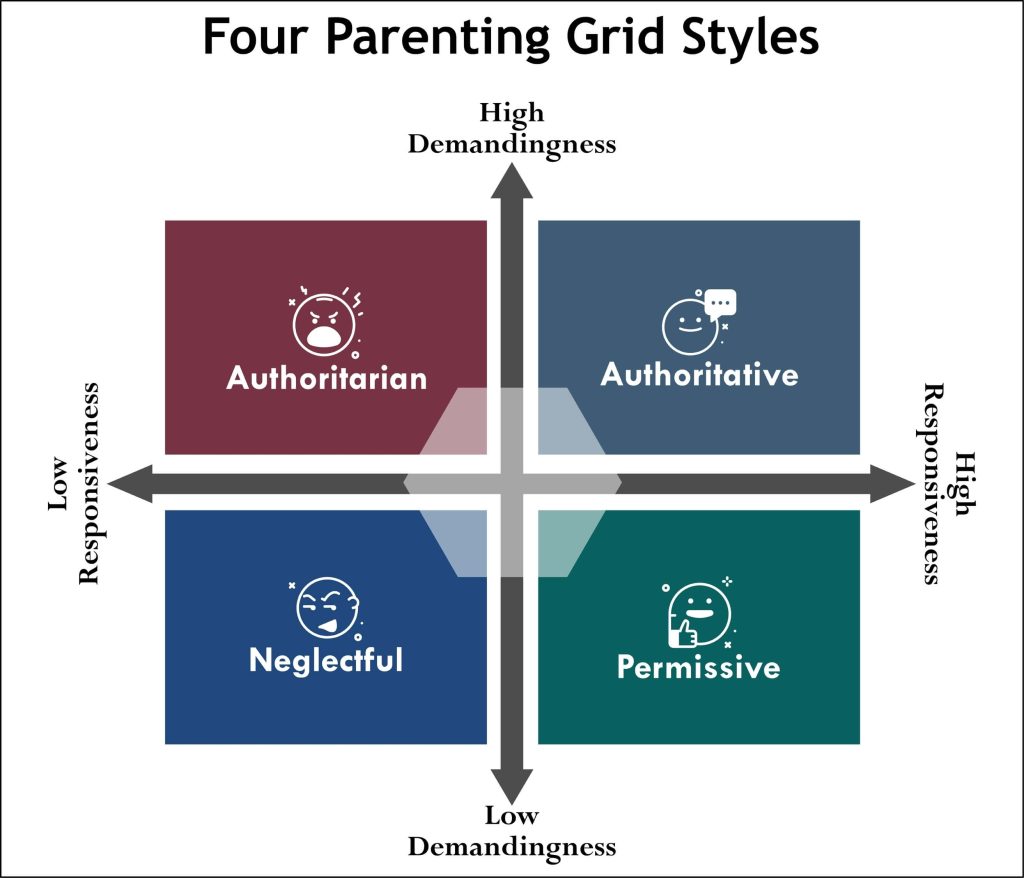
Skyline Graphics / Shutterstock.com
While authoritative parents and authoritarian parents may establish strict rules, the two types of parenting styles differ significantly, particularly in how warmth and intent are communicated.
Authoritative parents combine clear expectations with care, explanation, and responsiveness, encouraging the child to develop autonomy and emotional intelligence to guide themselves towards the parents’ valued outcome. Children of authoritarian parents tend to experience rigidity and punishment to force the parents’ valued outcome.
→→→
| Feature | Authoritative | Authoritarian |
| Communication | Open, two-way, empathetic | One-way, directive |
| Emotional Warmth | High | Low |
| Strict rules | Firm but explained | Strict & non-negotiable |
| Discipline | Natural consequences | Punishment & obedience |
| Indipendence | Encouraged | Restricted |
| Child’s Role | Involved & heard | Expected to obey |
⠀
While both styles share similarities, there are very clear and consistent consequences for each.
Discipline and Boundaries: How They Differ in Practice
Discipline and boundaries exist in every household, but the way they are enforced varies widely. Different parenting styles can be characterised by how they apply rules in practice, and how they incorporate control, explanation, and emotional connection to shape a child’s behaviour.
Bedtime
A study looking at the correlation between bedtime routines and child development found that the warmth associated with the reinforcing behaviours of the authoritative parenting style resulted in better sleep behaviours, as opposed to the rigid rules and expectations set by the more authoritarian parent.
Authoritarian approach
- Parent: It’s bedtime.
- Remi: Why do I always have to go to bed so early? I’m not tired.
- Parent: It’s eight o’clock. You know the rules. Up to bed.
What’s happening?
⠀
If Remi were to argue their case for a later bedtime, the authoritarian parent is more likely to stand their ground because strict parental rules are non-negotiable and their dictated behaviour is expected to be followed without question or explanation.
Authoritative approach
- Parent: It’s bedtime.
- Jude: Why do I always have to go to bed so early? I’m not tired.
- Parent: Sleep isn’t just about being tired—it’s when your brain and body reset. Getting enough sleep helps you concentrate and better manage your feelings. Plus, you also grow when you’re asleep. That’s why bedtime matters, even on nights when you don’t feel sleepy yet.
- Jude: OK. Can I read in bed for a bit?
- Parent: That sounds fair. One chapter, then lights out—deal?
What’s happening?
⠀
This approach explains the logic for the routine and offers a gentle compromise, reinforcing Remi’s autonomy in her own decision-making, while preserving the boundary.
Screen Time
a recent study published by Nature examined the relationship between screen time routines and child development. It concluded that children of authoritative parents tend to possess healthier media habits.
Authoritarian approach
- Parent: Turn it off now.
- Remi: But I’m not finished!
- Parent: I don’t care. You know the rules.
- Remi: It’s not fair.
- Parent: Turn it off now, or you won’t have any screen time tomorrow.
What’s happening?
⠀
Authoritarian parenting focuses on threat and control to enforce the boundary. Remi complies, but with frustration and resentment. The rule is followed, but the reason for it remains ambiguous.
Authoritative approach
- Parent: Hey Jude, you’ve got five minutes left on that screen.
- Jude: Just one more episode?
- Parent: You know that too much screen time isn’t good for you. What have we talked about before? Remember: it can reduce your attention span, which can make school feel harder, and it can make it difficult to get a good night’s sleep.
- Jude: Can I just finish this?
- Parent: It looks like there are 5 minutes left. Ok, finish this episode. Five minutes, then the tablet goes away.
What’s happening?
⠀
The boundary is firm, but the child is heard and offered logic. Jude feels respected, understands the reason for the rule, and stays engaged in the transition—not just compliant, but cooperative. This explanation is reinforced over time, so Jude can eventually internalise it, helping them learn to negotiate their own screen time boundaries as they head into young adolescence and supporting the development of their emotional intelligence.
School Performance
Longitudinal research by Steinberg et al. (1992) found that adolescents whose parents combined warmth, supervision, and encouragement showed higher academic achievement and school engagement, particularly when parental support in schooling was strong.
Authoritarian approach
- Parent: Look at your homework book, you’ve got this whole page of questions wrong.
- Remi: I tried, but I didn’t really understand it.
- Parent: That’s not good enough. You know the rules: no gaming until I’m satisfied that it’s done properly.
What’s happening?
⠀
Authoritarian parents reward children for their successes, but lack the nurturing relationships that mould early childhood. Remi feels pressure and fear of failure, with no parental support on how to improve, their self-confidence and self-worth become significantly damaged.
Authoritative approach
- Parent: Look at your homework book, you’ve got this whole page of questions wrong.
- Jude: I tried, but I didn’t really understand it.
- Parent: Ok, let’s take a look at this first question. I’m sure we can work out what it’s asking together.
What’s happening?
⠀
The parent responds with support rather than blame, validating Jude’s effort and offering guidance. This encourages problem-solving, builds confidence, and frames mistakes as learning opportunities as opposed to failures, supporting the child’s well-being.
Misbehaviour in Public
Research in developmental psychology shows that children’s behaviour in public settings is strongly influenced by how parents manage boundaries and emotional regulation. Authoritative parenting is associated with better self-control and fewer disruptive behaviours.
Authoritarian approach
- Remi: Can we buy these sweets, please?
- Parent: No. Put them back.
- Remi [in a loud and desperate tone]: But I’m so hungry, and I really want them. Please?
- Parent [matching Remi’s volume, but with an aggressive tone]: I said no. Put them back now, you’re embarrassing me.
- [Remi throws the packet on the floor and starts crying.]
What’s happening?
⠀
Authoritarian parents teach children through command and fear. Remi’s emotions escalate because the child is corrected without explanation or emotional support.
Authoritative approach
- Jude: Can we buy these sweets, please?
- Parent: No. Please put them back.
- Jude [in a loud and desperate tone]: But I’m so hungry, and I really want them. Please?
- Parent [crouching to meet Jude’s eye level]: Sweets aren’t going to fill you up if you’re hungry. How about we put them back, and you can choose what we buy for our dinner instead.
- [Jude hesitates, then calmly puts them back.]
What’s happening?
⠀
The parent acknowledges the child’s feelings, explains the boundary, and redirects behaviour. Jude learns emotional control and problem-solving through positive discipline, even in a potentially stressful public moment.
Friendship Conflicts
Research in child psychology shows that children learn how to handle peer conflict through everyday interactions with caregivers. Parenting styles that combine emotional warmth with guidance are associated with stronger social problem-solving skills and healthier peer relationships.
Authoritarian approach
- Remi: My friends wouldn’t let me play with them today.
- Parent: Why not? What did you do?
- Remi: Nothing.
- Parent: Well, next time, tell them you don’t want to play with them either, then tell the teacher they’re being mean. You’re not going to be a pushover.
What’s happening?
⠀
The parent dismisses Remi’s feelings and jumps to control-based solutions. Remi learns to view conflict as something to avoid or dominate rather than understand.
Authoritative approach
- Jude: My friends wouldn’t let me play with them today.
- Parent: That must have felt really upsetting. Why do you think that might be?
- Jude: I don’t know… maybe they already had enough players.
- Parent: That makes sense. What could you say tomorrow that might help?…
What’s happening?
⠀
The parent validates the emotion, explores perspectives, and helps Jude develop problem-solving skills to manage peer-conflict constructively.
Effects on Child Development

FAMILY STOCK/Shutterstock.com
As discussed in the article Am I an Authoritarian Parent? How to Recognise Your Style and Its Impact, although authoritarian parenting styles can manage behaviour in the short term, it does so at the cost of a child’s health, emotional well-being, self-regulation, and long-term resilience.
Raising children on strict rules and threats of physical punishment associated with authoritarian parenting styles has been proven to negatively impact psychological development and lead to hostile attribution bias.
Emotional and Psychological Effects
Clear, consistent boundaries and high expectations are synonymous with both authoritative and authoritarian parents. Key differences between the types of parenting are how they administer consequences.
The authoritarian parent uses threats of punishment and withholding affection to force the desired behaviour, vs the authoritative parent who employs logic, gentle reasoning, and negotiation.
The outcomes may appear the same, but how those strict rules and instructions are administered impacts the whole of a child’s life. It affects their emotional well-being and psychological growth.
Comparison of authoritarian and authoritative parenting pathways and their emotional outcomes:
| Authoritarian | Authoritative |
| Low self-esteem | High Emotional Intelligence |
| Fear-Based Compliance | Confidence & Autonomy |
| Threats of Punishment | Logic & Negotiation |
⠀
As the table shows, authoritarian approaches emphasise threat and obedience, which can result in overtly aggressive children who lack the proper guidance to develop effective coping strategies. By contrast, authoritative strategies teach boundaries, build responsibility, and emotional intelligence to support good self-esteem.
Social Skills and Relationships
In a supportive environment with positive reinforcements characteristic of an authoritative parenting style, children tend to display more developed empathy, stronger collaboration skills, and higher self-esteem, enabling them to form positive relationships.
Authoritarian parenting is associated with greater rigidity in social interactions, more frequent conflict and negative emotions, as children tend to have fewer opportunities to practise negotiation, cooperative problem-solving, and effective coping strategies.
a recent study found that authoritarian parenting is associated with attachment anxiety and avoidance in adult romantic relationships, while authoritative parenting is linked to more secure attachment patterns.
This suggests that parents raised on authoritarian values are more likely to develop insecure relationship patterns characterised by mistrust and fear of intimacy.
Furthermore, research consistently confirms that authoritarian parenting undermines social competence and peer relationships and is linked to patterns of aggressive behaviour.
Academic and Behavioural Outcomes
an investigative report carried out by the UK government found that parenting styles that employ harsh and inconsistent disciplinary measures were associated with significantly higher levels of severe antisocial behaviour in children.
| Authoritarian | Authoritative |
| Rigidity | Respectful communication |
| Obedience | Collaboration |
| Fear of mistakes | Emotional awareness |
| Reliance on authority | Accountability |
| Difficulty expressing emotions | Empathy |
| Conflict avoidance or aggression | Problem-solving |
| Low trust | Trust in relationships |
| Conditional self-worth | Healthy independence |
⠀
Learned values and social patterns from each parenting background manifest consistently in adolescence and adulthood.
Authoritative parenting correlates with psychosocial competence and emotional well-being, whereas authoritarian parenting is associated with aggression, anxiety, and social difficulties.
A cross-sectional study published in Annals of Medicine, found that children from more authoritarian homes tend to have lower self-esteem: “Authoritative parenting was the most common and the only parenting style with a statistically significant positive correlation with self-esteem.” (Fahud et al. 2024.)
These findings are consistently reinforced, evidencing that anxiety in childhood and young adolescents is more often associated with an authoritarian upbringing. The paper Effects of Parenting Styles on Anxiety, concluded that this correlation is due to the child’s basic lack of the emotional intelligence required to make their own choices in an emotional climate.
“authoritarian parenting, characterised by rigid regulations and a lack of emotional support, can contribute to higher levels of anxiety in children. … In contrast, authoritative parenting, which combines firm guidelines with emotional support, has been found to lower anxiety levels in children. The paper concludes that understanding the effects of parenting styles on anxiety is crucial for promoting the well-being and mental health of children and adolescents.” (Yang, 2024.)
In addition to a healthier mind, a meta-analysis and multiple studies have found that: “An authoritative parenting style has consistently been associated with positive developmental outcomes in youth, such as psychosocial competence and academic achievement.” (Kuppens & Ceulemans, 2019, J Child Fam Stud.)
Other studies have also found that parenting style influences academic success, with authoritative approaches linked to better grades and higher attainment.
Further research reinforces that an authoritarian parenting style is negatively correlated with educational success: “The results show a significantly negative relationship between the parents’ authoritarian parenting style and students’ educational success.” (Cupar et al. 2025.) Meaning higher levels of authoritarian control predict lower academic achievement and more negative attitudes toward schooling.
Cultural Context and Misconceptions

fizkes/Shutterstock.com
A common misconception is that strict parenting is universally effective, regardless of the child’s age, when in reality, children’s outcomes depend on how discipline is delivered, understood, and emotionally framed within their cultural context.
Authoritative parenting is proven to consistently result in positive academic performance, even in cultures where strict parenting is more common.
Why Authoritarian Methods Still Exist
In some cultures, particularly collectivist societies, parenting that resembles the authoritarian style may be interpreted as protective or supportive rather than harsh. (Terrence Sanvictores; Magda D. Mendez. 2022).
In the mid-1990s, a study into the association between asian adolescence school performance and parental control concluded that Western definitions and measurement tools fail to account for cultural nuances. Whereby parenting perceived as authoritarian is often experienced as supportive, duty-driven, and embedded within norms of family obligation and respect rather than as harsh or rejecting.
These findings challenged the assumption that authoritarian parenting results in universally negative outcomes, sparking a major debate about cultural bias in parenting research.
Misreading Authoritative as Permissive
Authoritative parenting is sometimes confused with the permissive parenting style, which is also characterised by a supportive environment with emphasis on warmth and open communication.
However, it differs greatly from authoritative parents, as it provides minimal structure and very few rules, with a focus on the child’s individuality, allowing freedom that can encourage creativity, yet often at the expense of self-discipline and responsible decision-making.
Children of permissive parents often develop strong emotional expressiveness and openness, but may struggle with limits, routine, and long-term goal-setting. This is not to be confused with neglectful parenting, also known as uninvolved parenting.
Children of neglectful parents tend to be emotionally detached and used to inconsistent parental guidance. They are more resilient and self-sufficient, but lack emotional skills and effective coping strategies. They are more likely to experience mental health issues.
Comparison of the emotional outcomes of authoritative and permissive parenting:
| Authoritative | Permissive |
| Automomy | Impulsivity Risk |
| Clear Boundaries | Blurred Boundaries |
| Emotional Support | High Freedom |
| Structure | Inconsistent Structure |
⠀
As shown in the table above, authoritative strategies build responsibility and emotional intelligence, with clear expectations and emotional support.
By contrast, permissive parenting lacks boundaries and emphasises freedom. Free to make their own choices regardless of the child’s age, they quickly learn to be self-sufficient in early childhood. These features are consistently linked to lower respect for social norms, impulsivity, and difficulties in structured environments. (Jeelani et al. 2025.)
How Both Styles Relate to Traditional vs Modern Research
Authoritarian, authoritative, and permissive parenting approaches were originally postulated by developmental psychologist Diana Baumrind in the 1960s, although these findings took several decades to make it into a family context.
Many Western societies continued to emphasise obedience and authority in children into the 21st Century. The article Are Children Still Seen and Not Heard, published by Taylor & Francis, notes that this expectation was part of the traditional adult-centric worldview that shaped parenting strategies for decades.
The paper suggests that shifts in attitude were shaped by broader social changes—for example, the United Nations Convention on the Rights of the Child in 1990 helped reinforce the idea of children as social actors, but this legal and ethical shift took years to translate into parenting norms at the family level.
The traditional adult-centric worldview is most closely aligned with authoritarian approaches. Modern developmental research repeatedly demonstrates that while strict control may produce short-term compliance, it is the blending of structure with emotional support and explanation that is more strongly associated with healthy emotional skills, self-regulation, and long-term well-being.
Finding Balance: Moving from Control to Guidance

Esther Pueyo / Shutterstock.com
In the post Authoritative Parenting — How to Balance Guidance and Freedom for Your Child, Lorrie Holmes suggests practical strategies for parents to employ when adapting to the authoritative approach.
Whatever your parenting style, it is most likely influenced by lived experiences, like education, supportive relationships, therapy, etc. Understanding and incorporating a balance of warmth and boundaries in your parenting style is vital to a child’s emotional well-being.
If you find yourself quick to yell and threaten punishment, here are some techniques to improve open communication and help transition from fear-based control to collaborative learning, without losing boundaries:
| Stop | Instead |
| Demand obedience without context.
“Because I said so!” or “Just do what I tell you!” |
Explain the reason for the rule.
“We need to get to bed on time so you’re rested for school tomorrow.” |
| Dismiss emotions.
“Stop crying!” “Don’t be such a baby!” |
Validate their feelings first.
“I know you’re frustrated. Let’s figure this out together.” |
| Make threats.
“If you don’t listen, you’re in big trouble.” |
Use logical consequences.
“We need to tidy up now, or we won’t have time to read in bed.” |
| Make up the rules yourself.
“I’m the parent, I decide!” |
Involve them in setting rules.
“Let’s decide our screen time limits together.” |
| After difficult moments, think:
“Was I trying to teach obedience or understanding?” |
Tools can help support that shift, too. Apps like Findmykids are designed to help parents set clear, consistent boundaries around things like screen time and safety—without constant control or conflict. When rules are transparent and predictable, it becomes easier to move from power struggles to cooperation, and from monitoring to trust.
Raising Children Who Understand, Not Just Obey
Authoritarian parenting can create the facade of an orderly household and compliant children, but research repeatedly demonstrates that control without warmth produces short-term obedience at a long-term emotional cost.
When a child’s feelings are discounted in favour of obedience shaped by rigid rules and limited explanation, they may struggle with confidence, trust, and emotional regulation well into adolescence and adulthood.
In contrast, authoritative parenting reframes discipline as guidance—preserving boundaries while fostering autonomy, empathy, and resilience. The difference is not about being stricter or softer, but about whether children are learning to comply or learning to understand.
Over time, it is understanding—not fear—that forms healthy adults.
FAQs
What is the difference between authoritative and authoritarian parenting?
The core difference lies in warmth and communication versus control and obedience. Authoritative parenting combines high expectations with emotional support, clear reasoning, and open dialogue, helping children build autonomy and self-regulation. In contrast, authoritarian parenting enforces strict rules with little explanation, uses harsh punishment, and expects unquestioning compliance—often resulting in short-term obedience but long-term emotional challenges.
What does authoritarian parenting do to a child?
Children raised by authoritarian parents are more likely to show high obedience but lower self-esteem, increased anxiety, and difficulty expressing emotions or making their own decisions.
What is an example of authoritarian parenting?
A parent insisting on rules being followed without explanation — such as demanding a child go to bed immediately “because I said so” — is indicative of authoritarian control.
Do authoritarian parents yell?
Not always, but authoritarian parents tend to rely on raised voices, threats, or punishment to enforce compliance rather than calm explanation or collaborative problem-solving.
What are the 4 parenting styles?
There are commonly considered to be four parenting styles: authoritarian, authoritative, permissive and neglectful—also referred to as uninvolved parenting. In her post What Are the 4 Types of Parenting Styles and Which One is Right for You? Rebekah Pierce examines the pros and cons of each parenting style.
What is the most effective parenting style?
Research consistently indicates that authoritative parenting—which combines clear boundaries with warmth, reasoning, and emotional support—is associated with the most positive outcomes across behaviour, relationships, and mental health.
What is the 7 7 7 rule for parenting?
The 7-7-7 rule in parenting has two main meanings. One is a daily connection strategy: 7 minutes of intentional time in the morning, after school, and at bedtime to strengthen emotional bonds. The other is a developmental guide: ages 0–7 focus on play, 7–14 on teaching, and 14–21 on guiding—helping parents adjust their role as the child grows. Both versions prioritize presence, consistency, and age-appropriate support.
What parenting style is best for ADHD?
Research and expert guidance suggest that an authoritative parenting style is most effective for supporting children with Attention‑Deficit/Hyperactivity Disorder. This approach blends warmth and responsiveness with clear expectations and consistent structure, helping children with ADHD feel supported while learning self‑regulation and positive behavior. Authoritative parents provide firm but fair rules, explain reasons behind expectations, and use logical consequences rather than harsh punishment—strategies linked with better emotional and behavioral outcomes in kids with ADHD.
Resources
- Bedtime routines child wellbeing & development, George Kitsaras, Michaela Goodwin, Julia Allan, Michael P. Kelly & Iain A. Pretty
- Associations between media parenting practices and early adolescent screen use, Jason M. Nagata, Angel Paul, Felicia Yen, Zacariah Smith-Russack, Iris Yuefan Shao, Abubakr A. A. Al-shoaibi, Kyle T. Ganson, Alexander Testa, Orsolya Kiss, Jinbo He & Fiona C. Baker. Pediatric Research, 2025
- Impact of Parenting Practices on Adolescent Achievement: Authoritative Parenting, School Involvement, and Encouragement to Succeed, Laurence Steinberg, Susie D. Lamborn, Sanford M. Dornbusch, Nancy Darling. Child Development, 1992
- Types of Parenting Styles and Effects on Children, Terrence Sanvictores; Magda D. Mendez. StatPearls Publishing / NCBI Bookshelf collection, 2023
- Exploring Parenting Styles Patterns and Children’s Socio-Emotional Skills, Aikaterini Vasiou, Wassilis Kassis, Anastasia Krasanaki, Dilan Aksoy, Céline Anne Favre, Spyridon Tantaros. Children, 2023
- Handbook of Moral Development, Melanie Killen, Judieth G. Smetana, 2013
- How is parenting style related to child antisocial behaviour? Preliminary findings from the Helping Children Achieve Study, Stephen Scott, Moira Doolan, Celia Beckett, Séan Harry, Sally Cartwright and the HCA team. Department for Education, UK Government, 2010.,
- Authoritarian Parenting, Parenting Science Blog, Gwen Dewar, 2024
- Relationship Between Parenting Styles and Romantic Attachment in Adults with Gender as a Moderating Variable, Dr. Aishath Shanoora, Unaisa Saud. The Maldives National Journal of Research, 2024
- The relationship between parenting styles and self-esteem of medical students with age and gender as moderators, Gul, Fahad MBBSa; Abbas, Khawar MBBSa; Saeed, Sajeel MBBSb; Haider, Tehseen MBBSb; Qayyum, Sardar Noman MBBSc; Noori, Samim MDd. Annals of Medicine and Surgery, 2024
- Effects of Parenting Styles on Anxiety, Chenyue Yang. Journal of Education, Humanities and Social Sciences, 2024
- Parenting Styles: A Closer Look at a Well-Known Concept, Sofie Kuppens & Eva Ceulemans. Journal of Child and Family Studies, 2019
- Effects of parenting styles on academic achievement: The moderating role of a country’s economic development, Tina Cupar, Rudi Klanjšek, Katja Košir, Miran Lavrič, Alexander T. Vazsonyi. Children and Youth Services Review, 2025
- Beyond parental control and authoritarian parenting style: Understanding Chinese parenting through the cultural notion of training, Chao, R. K., Ovid, 1994
- Exploring the Impact of Parenting Styles on the Social Development of Students in Early Childhood Education Training, Shumaila Jeelani, Arz Sama, Dr. Hina Gul, Dr. Um E Rubab, Ms. Ayesha Nazir Gill, Dr Saira Maqbool. Advances in Consumer Research, 2025
- Are Children Still Seen and Not Heard?, Lauren Elizabeth Lines, Alison Hutton, & Julian Maree Grant. Comprehensive Child and Adolescent Nursing, 2022
Cover image: fizkes / Shutterstock.com
Проверьте электронный ящик