















If you’ve ever sent your teen a message and received nothing back but “k,” “fine,” or “lol,” then you’ve experienced dry texting firsthand.
While it’s often seen as rude, dismissive, or even a sign that something might be wrong, the reality is far more nuanced than that (as it so often is in texting slang!).
Once you understand the way your teen communicates and why, you can avoid unnecessary conflict as a parent and build stronger communication habits to last a lifetime.
Key Takeaways
- Dry texting is a common form of digital communication among teens and doesn’t automatically mean a child is angry, sad, or uninterested.
- Many teens use short messages, one-word replies, and brief responses because they’re busy, multitasking, or communicating in a way that feels normal within their social circles.
- A pattern of dry texting can sometimes signal emotional withdrawal, friendship issues, stress, or other challenges when combined with changes in behavior.
- Parents should focus on overall communication patterns rather than judging a relationship based on a single message or conversation.
- Tools like Findmykids can help parents stay connected and informed without relying solely on texting for updates about their child’s whereabouts and safety.
Contents:
What Does Dry Texting Mean?
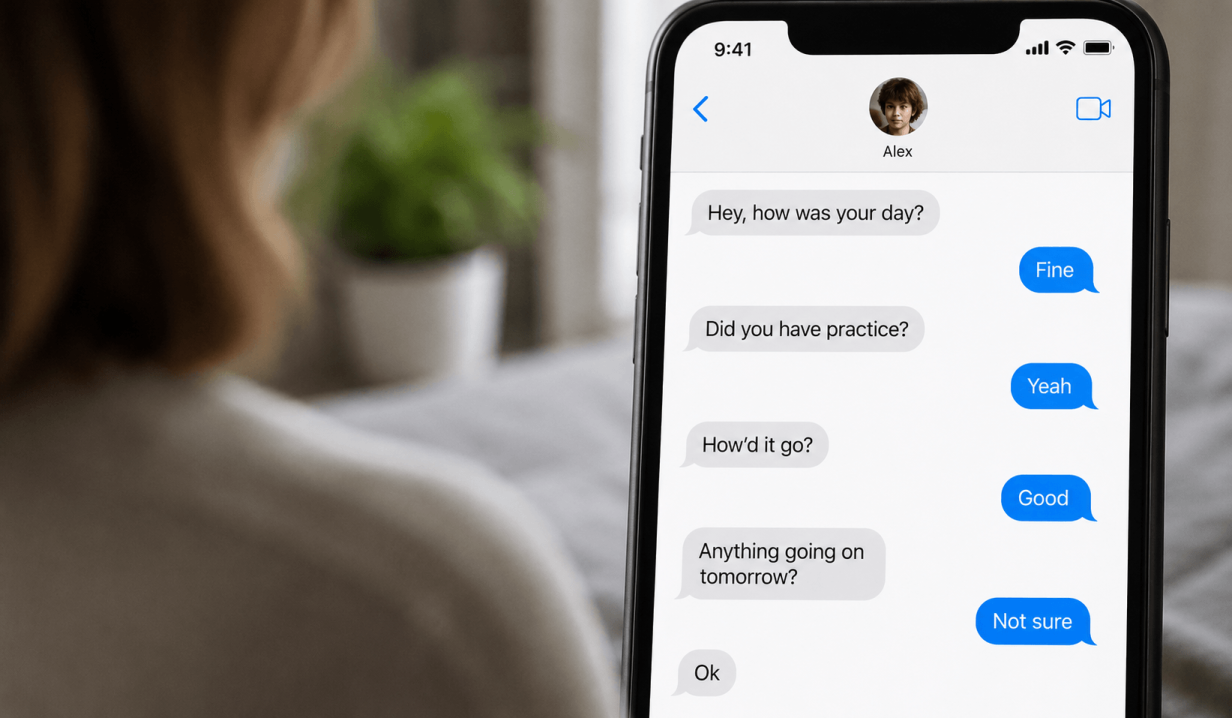
Dry texting refers to sending messages that are brief, offer little detail or context, and don’t actively move a conversation forward. In most cases, dry texting means a person is giving the shortest possible answer without adding much information, emotion, or engagement.
- For example, a parent might text: “How was school today?”
- Teen: “Fine.”
- Parent: “Anything interesting happen?”
- Teen: “No.”
- Parent: “How was your test?”
- Teen: “Good.”
The conversation quickly stalls because each answer provides precious little material for the other person to work with.
A dry texter, then, is someone who frequently sends short messages, one-word responses, or replies that lack substance. They might not necessarily be unhappy or angry; in many cases, they’re simply communicating efficiently or responding while they’re distracted.
Research in communication and clinical psychology suggests that digital communication often strips away nonverbal cues such as facial expressions, voice inflection, and body language. Without those signals, people may interpret neutral responses more negatively than intended. In other words, what appears cold on a screen may feel perfectly normal to the sender.
For teens especially, texting has become a highly functional form of communication, as well as a wholly natural one. Many use it to exchange information, not for deep emotional expression, saving more meaningful talking for in-person interactions, calls, video calling, or communication with a best friend.
Dry Texting Examples
@tristanleandergreen_ can’t lie i’ve been both sides #skit #acting #actor ♬ original sound – Tristan Leander Green
Not sure if what you’re seeing in those little blue boxes is dry texting? Here are some examples of dry texts in action so you know what to expect in the moment.
Common Dry Text Replies
Some of the most common examples include:
- K
- Ok
- Fine
- Yep
- Nope
- Sure
- Lol
- Idk
- Hey
- Cool
These one-word answers often frustrate the person on the receiving end because they don’t create opportunities for continued conversation.
Example 1
- Friend: “Did you have fun at Sarah’s party?”
- Teen: “Yeah.”
- Friend: “What was the best part?”
- Teen: “Idk.”
Example 2
- Parent: “Do you need a ride after practice?”
- Teen: “Yes.”
- Parent: “What time?”
- Teen: “6.”
Example 3
- Friend: “Hey, want to hang out this weekend?”
- Teen: “Maybe.”
- Friend: “What do you want to do?”
- Teen: “Whatever.”
In each of these examples, the responses technically answer the question, but require the other person to do most of the work to keep the conversation moving. Some teens send long paragraphs when they’re discussing topics they’re interested in, but switch to dry texting when they’re discussing something they find boring or unimportant. Context is incredibly important here!
Also check out our guide to popular teen emojis and the slang words that are trending among young people today.
Why Teens Use Dry Texting
As a parent, you might find yourself wondering whether your teen’s habit of dry texting means they’re upset, hiding something, or losing interest in a relationship. And while that can occasionally be true, there are far more common explanations.
They’re Busy
Many teens juggle school, sports, extracurricular activities, part-time jobs, and social commitments throughout the week, meaning they might be responding while they’re walking between classes, studying, or just hanging out with their friends.
Because of this, a quick answer isn’t always an accurate reflection of how much they care. Sometimes, it’s just the fastest way to respond.
They See Texting Differently
Many adults view texting as a conversation. For teens, however, texting tends to function more like a tool for exchanging information. A message such as “practice ends at 6” may feel complete and efficient while requiring minimal effort. To them, adding extra words feels unnecessary, like pulling teeth.
They’re Managing Multiple Conversations
Teens tend to communicate with multiple people simultaneously across various platforms, meaning their phones might be buzzing with constant notifications from group chats, social media, games, and direct messages. Because of this, response times can vary dramatically, so a delayed response or brief answer doesn’t always mean there’s a problem.
They’re Trying to Sound Cool
Among some teens, appearing overly enthusiastic can feel awkward. A short “lol,” “cool,” or “hey” may be viewed as more socially acceptable than an elaborate response, something that is especially common when they’re talking to a friend, a boy or girl who’s a potential romantic interest, or even someone they just don’t know well.
They Aren’t Interested in the Topic
Sometimes dry texting means exactly what parents fear: the teen simply isn’t interested in continuing that particular conversation.
A student who sends detailed messages about sports, music, or gaming but only responds with one-word replies about chores is sending a fairly clear signal about their priorities.
They’re Emotionally Tired
Dry texting can indicate physical exhaustion, sure, but it can also be a related sign of emotional fatigue. After a long day, your teen might lack the energy needed for extended communication, so dry texting might also reflect mental exhaustion instead of outright hostility.
Similarly, a person who’s dealing with stress, academic pressure, friendship drama, or family conflict may put less effort into responding to messages.
Is Dry Texting a Red Flag?

Freepik / magnific.com
Most of the time, no, dry texting by itself isn’t necessarily a red flag. Many healthy friendships and relationships include occasional dry texts.
However, as a parent, you should pay attention when dry texting appears alongside other changes. A pattern may warrant closer attention (and could be a sign of something bigger) if your child:
- Suddenly stops talking with close friends
- Withdraws from activities they previously enjoyed
- Seems consistently upset or bothered
- Shows changes in sleep habits
- Avoids family interactions
- Appears isolated throughout daily life
If a normally engaged teen suddenly becomes distant across multiple forms of communication, parents may want to gently explore what’s happening. The issue may involve:
- Friendship problems
- School stress
- Anxiety
- Depression
- Social conflict
- Bullying
- Relationship challenges
Again, one person sending a few dry texts for a day or two isn’t concerning, but a sustained shift in behavior over several weeks deserves attention.
Whatever you do, though, don’t automatically confuse or conflate dry texting with passive-aggressive behavior. While some dry texts can be intentionally dismissive, many are simply the product of modern communication habits.
How Findmykids Helps Parents Stay Connected Without Constant Conflict
Many parent-child disagreements start with repeated questions, like, “Where are you? When will you be home? Why aren’t you answering?”
When you rely entirely on texting for updates, dry texting can create unnecessary tension.
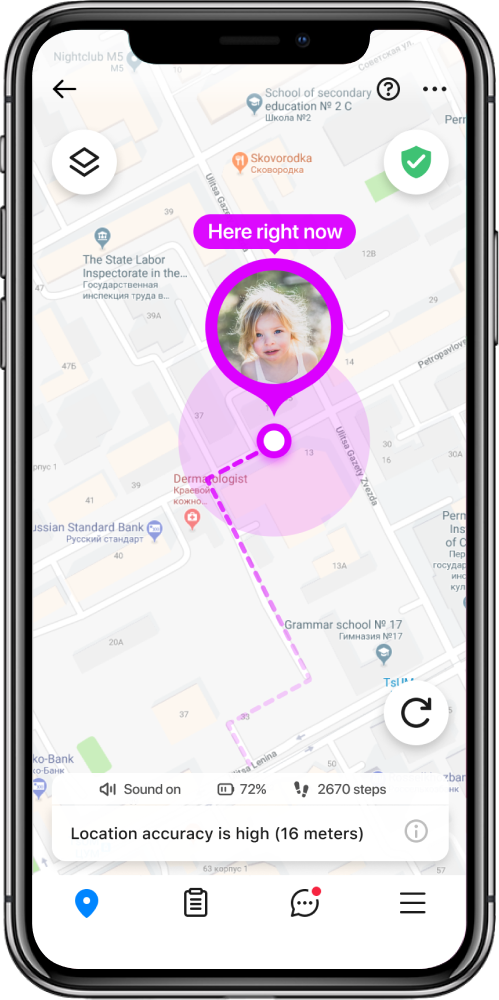
That’s where Findmykids comes in. A family safety app designed to help parents stay informed about their child’s location and activities, it also helps to reduce the need for constant check-ins.
Features That Can Help

Findmykids app
Findmykinds offers tools to reduce the pressure on teens to immediately answer every message, while also giving parents some necessary peace of mind. With Findmykids, parents can:
- View accurate real-time child location
- Receive movement notifications when children arrive at or leave specific locations
- Access detailed route maps and location history
- Use the built-in chat feature to communicate directly
- Send a bypass silent mode alert that sounds even if the phone is on silent
Depending on the plan and device type, Findmykids may also offer features such as app usage insights, app-blocking controls, website restrictions, and protection against unknown callers.
Most importantly, it lets you stay connected with your child without all the back and forth. When you don’t have to rely exclusively on text messages for reassurance, your conversations will likely become less stressful and more meaningful.
Findmykids helps families maintain connection while giving teens room to develop independence. Try it for free right now!
How Parents Can Respond to Dry Texting
Outside of apps, there are a few analog ways you can address your child’s dry texting habits.
Don’t Assume the Worst
Before you jump to conclusions or try to deduce your child’s state of mind by texts alone, consider alternative explanations. Your teen may be busy, distracted, tired, or simply using a texting style that feels normal to them. Simple as that.
Look at Patterns Instead of Individual Messages
One dry answer doesn’t explain much. Instead, look for trends over time, as the bigger picture matters more than a single message.
Are they still talking with friends? Are they engaged during family activities? Do they communicate normally in person?
Use Open-Ended Questions
Questions that require more than yes-or-no answers can encourage better communication.
Instead of: “Did school go okay?” Try: “What was the most interesting thing that happened today?”
It might feel weird at first, but asking open-ended questions makes it easier for teens to share details.
May be helpful: 30 Questions to Ask a Kid Instead of “How was your day”?
Consider a Different Channel
Some conversations simply work better outside texting. If an issue seems important, consider talking face-to-face, making a phone call, or using video calling instead. Many teens communicate more comfortably when they can hear tone and see reactions, and may not have enough confidence to initiate conversations in ways they’re most comfortable with.
Avoid Turning Every Dry Reply Into a Conflict
Repeatedly criticizing a teen for dry texting can make communication even more difficult. If every short response leads to an argument, your child may become less interested in engaging at all.
Model the Communication You Want
If you want thoughtful responses, you need to demonstrate them. Ask follow-up questions. Show interest. Listen carefully. Make space for conversation without immediately correcting or judging.
Remember That Relationships Change
This one is often the hardest pill for parents to swallow, and that is that communication evolves throughout adolescence. A child who once eagerly shared every detail of their day may become more private as they grow older. It can be bittersweet, but it doesn’t necessarily mean the relationship is suffering. Often, it simply reflects a natural stage of development.
Read more: Signs of a Toxic Teenager: When Normal Teen Behavior Crosses the Line.
Understanding the Message Behind the Message
As a parent, it’s totally normal to worry that dry texting means something is wrong. Sometimes it does, but more often, it’s simply a reflection of how modern teens communicate through their phones.
Pay attention to your child’s overall behavior and do your best to keep the lines of communication open. Whatever you do, resist the urge to overanalyze every single message.
A short answer doesn’t always tell the whole story. Sometimes “lol,” “cool,” or “fine” is just that. The stronger indicator of a healthy relationship is what happens across everyday life, not what appears in a single conversation thread.
FAQs
What does dry texting mean?
Dry texting means sending brief, low-effort messages that provide little information and do not help continue a conversation. Examples include replies such as “k,” “fine,” “lol,” or “sure.”
Is dry texting rude?
Not necessarily. While some people interpret dry texting as rude, many teens simply use short responses as part of their normal communication style. Context and overall behavior are important here.
Is dry texting a red flag?
Occasional dry texting is not usually a red flag, though it can be frustrating. However, if it appears alongside withdrawal, mood changes, social isolation, or other concerning behaviors, it may be worth exploring further.
How should I respond to a dry texter?
Stay calm, avoid overreacting, and focus on maintaining open communication. Use follow-up questions, communicate through calls when appropriate, and pay attention to broader patterns rather than individual messages.
Sources & References
- Why Therapists Are Begging People To Stop ‘Dry Texting’, Parade, 2024.
- The Impact of Digital Communication on Interpersonal Relationships, Journal for Research in Applied Sciences and Biotechnology, 2025
- Fine, I admit it – I am a ‘dry texter’. It beats emojis or verbal diarrhoea, The Guardian, 2023
Cover image: generated by ChatGPT / OpenAI
Проверьте электронный ящик