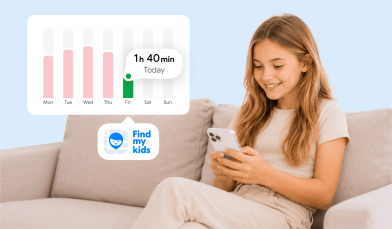
















You pick up your phone screen to check the weather, and twenty minutes later, you’re watching a stranger power-wash a driveway on TikTok.
If you’re wondering where your day went—or how your child’s phone habits compare to your family’s overall screen time—looking at the data on average phone screen time is the best place to start.
Contents:
What “Screen Time” Actually Means
Before we throw numbers around, we need to agree on definitions. Screen time has become a catch-all term, but not all pixels are created equal.
Phone Screens vs. The Rest
When researchers discuss screen time, they often conflate televisions, computer screens, tablets, smartwatches, and smartphones. But for most parents, the primary concern isn’t the family TV in the living room; it’s the personal, pocket-sized phone screen that follows their kids everywhere.
Phone screen time is distinct because it’s fragmented. For instance, you watch a movie on TV for two hours straight. You check your phone for thirty seconds, but you do it eighty times a day. The average time spent on these micro-uses adds up quickly, creating phone screen time habits that most people barely register until the daily average screen time report shows a figure like 4 hours or more.
With computer screens, the situation looks different. That’s mostly work or study, things like documents, coding, virtual class. TV time, on the other hand, is more about passive consumption. Your screen exposure from phones is a blend of the two: communication, passive scrolling, gaming, even payment systems or controlling light switches, and all of these factors into overall screen usage.
How We Measure the Minutes
Most tracking tools, like Apple’s Screen Time or Android’s Digital Wellbeing, record the time your phone screen is awake and unlocked, with this “active” metric covering everything from social media apps to communication devices.
Yet it’s not perfect. Playing Spotify with your phone locked doesn’t count. Or if you’re using a phone screen while also catching up on a movie, the data doesn’t stack those minutes. Studies that try to account time spent often use different definitions, which is partly why average screen time statistics hop around, sometimes clocking in at six hours, sometimes well over seven, all depending on the methodology.
But accurate screen time statistics matter, especially if you want to set screen time limits and track children’s screen time for school-aged children. You’ll want to know whether the 3 hours that were reported were spent reading ebooks, watching television, or scrolling social platforms.
What Is the Daily Average Screen Time?
If you worry the family’s glued to its screens, so is everyone else. The average American spends more than half their waking hours on one kind of screen or another.
All Screens vs. Phone-Only
What Is the Average Phone Screen Time?
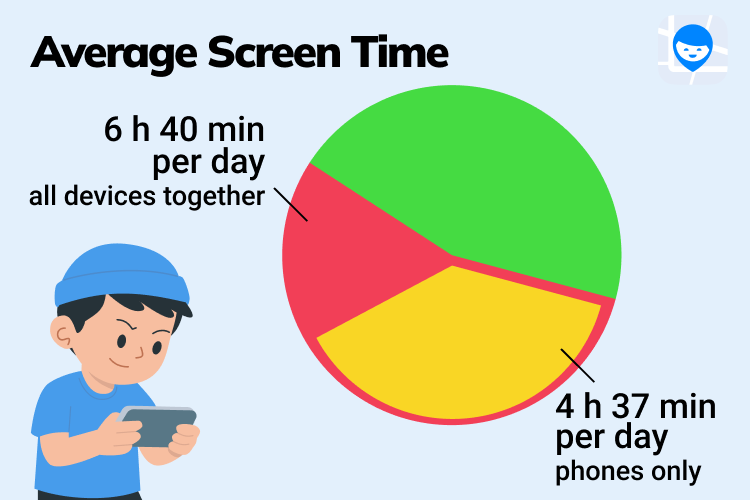
Take all devices together (tablets, TVs, computer screens, mobile devices, even light switches connected to smart homes) and the global average time clocks in at about six hours and 40 minutes per day. That’s a daily average screen time of nearly seven hours for the average person everywhere, based on shared health statistics as of March 2025.
Phones eat up a big slice of this. Strip away computer screens and tablets to count strictly phone screen time, and the numbers shift. The average screen time attributed to just phones lands around 4 hours and 37 minutes per day, according to industry research. With Gen Z and even the younger generation, you’ll find more than double that figure for daily screen time.
Breaking It Down by Age Group and Generation
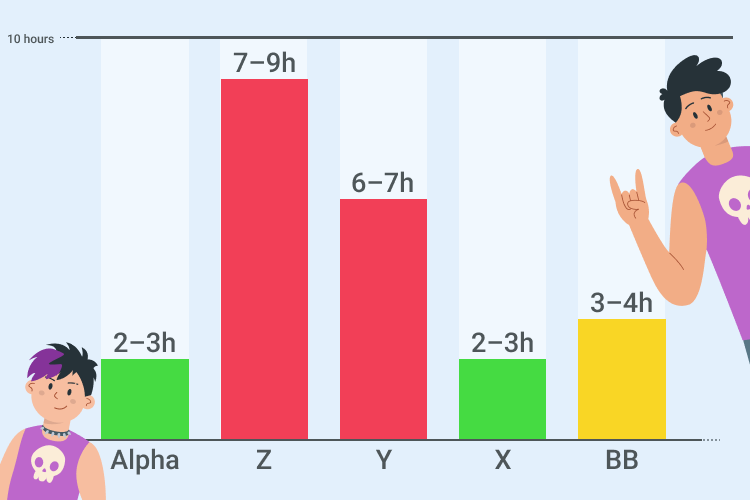
Average Screen Time Statistics by Generation
“Аverage person” is a moving target, since age group, cultural habits, and even daily routine all shift the numbers. Let’s break it out.
Gen Alpha (Born 2012–2025)
Screen exposure jumps as soon as the first phone arrives. School-aged children (6–12) spend an average of two hours or three hours with their phone screens during a regular weekday, often more on weekends.
With online homework, this figure sometimes climbs. Children’s screen time outside of school, however, is usually entertainment-based: viewing YouTube, playing mobile games, using social media apps, or exploring streaming services.
Gen Z (Born 1997–2012)
This younger generation practically grew up with a phone screen in hand. Several studies and survey respondents consistently record daily averages above seven hours; some report daily screen time hitting almost nine hours.
A lot of that’s on social media apps or streaming services. TikTok, YouTube Shorts, and Snapchat dominate here. Their average time spent is way above what baby boomers spend or what experts suggest for adolescent health.
Millennials: Gen Y (Born 1981–1996)
Millennials’ average daily screen time on phones hovers right around six to seven hours. Email, banking, and work blend in with social media. Facebook takes a back seat to Instagram, and time spent on communication devices or streaming services is high, though not as persistent as Gen Z.
Gen X (Born 1965–1980)
Gen X is catching up, with daily average screen time for phones is around two to three hours. While they lean on phone screens for news and communication, Facebook and WhatsApp claim a solid chunk of screen usage, alongside searching, shopping, and in-person experiences planned on their phones.
Baby Boomers (Born 1946–1964)
Ignore the outdated stereotype, because Baby Boomers spend more time on screens than you might expect. Baby boomers’ average daily screen time is three to four hours on phones, with tablet use pushing the total higher.
Baby Boomers spend most of their phone time on social media like Facebook, catching up via email, managing payment systems, or even playing games. Recent average screen time among Baby Boomers has increased sharply since 2020.
Average Time Spent, Geography, and Nuance
The global average, as of 2025, is still nearly seven hours per day. In the U.S., the average American can easily spend an average of four hours a day just with their phone, according to screen time statistics collected by survey respondents. That means almost half the total daily screen time (more than double that of earlier eras) is now mobile.
And remember, adults spend hours juggling between work computer screens, payment systems, and personal phone use. The daily average screen time is only going up.
Where Does the Time Go?
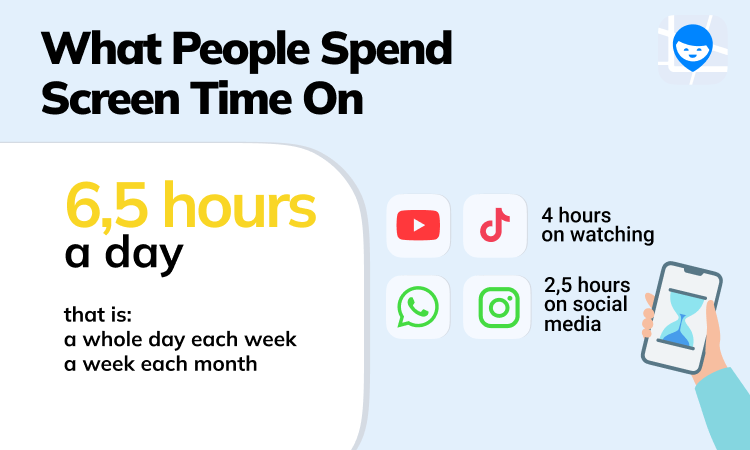
What People Spend Screen Time On
It’s not just how much screen time people spend, but where it actually gets spent that matters for mental health and physical health.
Social Media: The Ultimate Time Magnet
Social media and social media apps are built to keep you scrolling. The “infinite scroll” in TikTok, Instagram, and other social media apps sucks up significant time.
Survey respondents indicate that 2 hours and 24 minutes of the average daily screen time is lost to social media alone (often phone screen-based), and for teenagers, it’s more than double that. People spend a huge chunk of their phone screen time hopping from platform to platform.
On Instagram, even light switches (smart home tech!) trigger a dopamine hit. Facebook still leads for Baby Boomers. TikTok is a Gen Z powerhouse. The time spent is not just by the younger generation; adults spend growing amounts of daily screen time with social media apps as well.
Read also: Revealing the 5-Hour Screen Time: What Kids are Doing on Their Phones.
Streaming Services and Entertainment
Netflix, YouTube, and similar streaming services eat through hours, too. For Gen Z, YouTube is a video site, but also serves as a classroom, radio, and TV rolled into one. Daily screen time here quickly stacks above four hours if you include both passive watching of television and background video streams. With platforms releasing content continuously, screen exposure outpaces old-school channel surfing.
The average time spent across various age groups watching television or streaming services often matches or exceeds phone-only time for older age groups. Baby Boomers spend more time watching television, but their screen time on phones has surged recently.
Communication and Everything Else
Communication devices today mean much more than calls, with Snapchat, FaceTime, Discord, and constant group chats eating up part of your average screen time as well. Communication on a phone screen might also mean managing payment systems, controlling smart home light switches, or organizing family in-person experiences.
A family group chat can account for time spent jumping in and out of notifications all day. Screen breaks (if they happen) usually get ignored until the phone’s battery demands it.
How Much Screen Time Is Too Much?
Numbers differ, but the impact on physical health, mental health, and cognitive development is clear.
Researchers and organizations offer screen time limits, but use common sense as well. For early childhood (under 2), recommended screen time is zero except for video calls. For ages 2–5, the AAP recommends no more than one hour per day, and it needs to be high-quality programming (think educational shows, not random YouTube videos).
From age 6 onward, the focus is on balance: screen use should never replace sleep or physical activity. When children’s screen time climbs above two hours daily (assuming it’s not for schoolwork), you’re heading into excessive screen time territory, which correlates with mental health concerns, disease control challenges, and weight gain in various age groups. Even for adults, experts suggest non-work screen time should hit less than two hours daily, which most people blow past.
For reliable guidelines, see our recommended screen time by age resource.
Risks of Excessive Screen Time
Too much screen time brings adverse health outcomes, proven by health statistics from WHO, AAP, and CDC. Here’s what shows up across all age groups:
- Sleep Disruption: The blue light from screens interrupts melatonin, making sleep elusive. Expect trouble going to bed and an increased risk of morning drowsiness.
- Physical Health Risks: More time spent sitting means more than half of youth are missing out on recommended physical activity. In the long term, that’s linked to weight gain, poor cardiovascular health, and concerns about disease control.
- Attention Fragmentation: The constant ping of notifications leads to anxiety symptoms, shallow focus, and time wasted multitasking.
- Stunted Social and Cognitive Development: Especially in early childhood, excessive device use interferes with picking up critical in-person experiences like reading emotional cues, facial expressions, and spontaneous problem-solving.
- Eye Strain: Computer vision syndrome isn’t just for adults. Kids feel dry eyes, blurry vision, and headaches, especially with four hours a day or more in front of a phone screen.
Excessive screen time, particularly in adolescents, is linked to negative mental health effects, including depression and anxiety symptoms. Multiple academic reviews and health statistics warn of increased risk of such outcomes in populations with high daily screen time.
Signs Your Child Might Be Overdoing It
How do you know if excessive screen time is a problem? If these scenarios sound familiar for your child, reconsider their phone screen time habits and overall screen exposure:
- Withdrawal when the phone is removed (anger, anxiety)
- Loss of interest in hobbies, physical activity, and in-person experiences
- Deceptive behavior (sneaking phone use after bedtime)
- Chronic tiredness despite long periods “at rest” (usually due to blue light)
- Choosing screen usage over people (avoiding friends, less social activity)
Checking these signs can help parents spot when children’s screen time or adolescent daily screen time tips into unhealthy territory.
Related: Effective Ways to Break Free from Phone Addiction.
How Findmykids Helps Parents Manage Screen Time
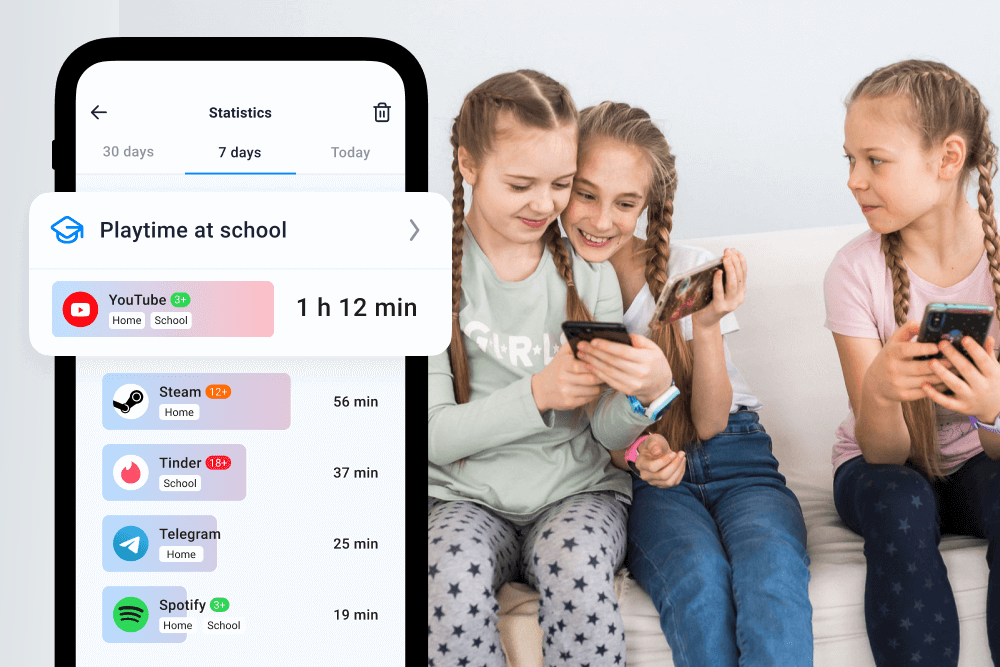
Findmykids app
Looking at average screen time statistics is only half the battle. Managing screen usage and setting limits—especially for children and teens—is where real tools make a difference. That’s exactly where Findmykids comes in.
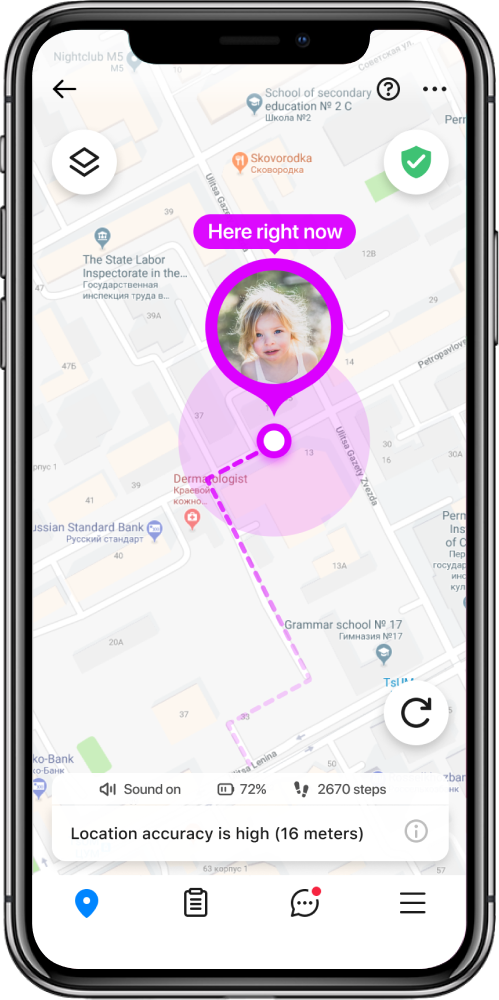
Beyond just location tracking for younger kids, it gives parents visibility into app usage across smartphones and tablets, so you can see exactly how much time is being spent on social media, streaming platforms, or games. With detailed app usage stats, you can set limits based on real data, spark meaningful conversations about healthy digital habits, and act before screen time spirals out of control—because those 6 hours and 37 minutes each day don’t disappear on their own.
If you notice that Roblox is creeping up to four hours daily, or social media apps are dominating evenings, you have the facts to act calmly and confidently. The app also supports full app blocking if necessary, ensuring that limits are respected even when children might be tempted to bypass them.
Meanwhile, the GPS and geofencing tools let you enforce phone-free periods for outdoor play, exercise, or family time, while still knowing your child’s location. This combination of online oversight and offline safety means you can protect mental health, encourage in-person experiences, and maintain a healthy balance between screens and real life.
With Findmykids, you’re not just monitoring—you’re guiding. It’s a practical, peace-of-mind solution that helps parents stay connected, informed, and proactive without hovering, letting kids grow responsibly while staying safe.
Download Findmykids today to set healthy screen time limits, track app usage, and give your child the freedom to explore safely—both online and in the real world.
Other Methods to Limit Screen Time Without Going Extreme
Total phone bans rarely work. Try these instead: each is proven to curb excessive screen time and support physical health without making you the enemy.
- Designate phone-free and screen-free zones (especially bedrooms and eating areas), so phones get breaks too.
- Institute the 20–20–20 rule: after 20 minutes of screen exposure, have your child look at an object 20 feet away for at least 20 seconds to dodge eye strain.
- Walk the talk. When adults spend mealtimes with their phones, children mimic those phone screen time habits.
- Turn on grayscale mode to sap the fun out of notification bubbles.
- Remove charging cables from bedrooms—use an old-fashioned alarm clock.
For more strategies, see how to reduce screen time. There are even tips for how to schedule screen breaks, so screen use doesn’t dominate downtime.
Taking Back Control
Nobody’s calling for digital exile. In fact, mobile devices, social media apps, streaming services, and messaging tools are realities of modern life, driving everything from school to payment systems to even light switches in smart homes.
But being intentional means you spend an average of four hours a day on your phone screen and not a minute more, especially if those extra hours and 37 minutes threaten physical health and mental health.
It’s less about strict screen time limits and more about informed choices. Your screen usage should help (not harm) your or your kids’ adolescent health, sleep, or relationships. You want them looking back on in-person experiences, not just average daily screen time statistics.
FAQs
What is the average phone screen time per day?
On mobile phones alone, the global average phone screen time is approximately 4 hours and 37 minutes. This daily average screen time is on the rise for all age groups.
What is the average daily screen time (all screens) globally?
Across all devices (computer screens, TVs, tablets, phones, and even light switches where relevant), the average daily screen time is 6 hours and 37 minutes.
How much screen time is too much for adults?
Screen time limits aren’t set in stone for grown-ups, but when screen use nudges out physical health, sleep, relationships, or daily activity, it’s too much screen time. Many suggest adults keep their non-work screen time under two hours per day.
How much screen time is too much for school-aged children?
Children’s screen time deserves careful tracking. For school-aged children, screen time limits should aim for a maximum of two hours of recreational use outside of schoolwork; excessive screen time can snowball into mental health and physical health issues quickly.
Does higher screen time cause mental health problems?
Multiple studies link daily screen time above four hours (especially for adolescents and the younger generation) to negative mental health outcomes, including anxiety symptoms and depression. While it’s not the only risk, it’s a major factor for adolescent health.
What are the most effective ways to limit screen time?
Keep phones out of bedrooms. Set up phone-free meal times. Model healthy screen usage yourself. Use tools like Findmykids to monitor average screen time and set realistic screen time limits.
How do I schedule screen breaks during work/school?
Try the Pomodoro technique. For every twenty-five minutes of screen usage, take five to step away from the screen: stand up, stretch, move around. Repeat throughout the day to protect mental health and physical health.
Why do different sources report different average screen time statistics?
Methodology varies wildly. Some researchers rely on people to estimate their daily average screen time, others account time spent with precise tracking apps, and the definition of “screen time” (all screens vs. phone-only vs. TV) shifts widely. This explains why survey respondents’ answers and reported daily screen time statistics can seem inconsistent.
Resources
- Excessive screen time is associated with mental health problems in US children and adolescents: physical activity and sleep as parallel mediators, Ying Dai & Na Ouyang, Humanities and Social Sciences Communications, 2026
- Screen Time Guidelines, The American Academy of Pediatrics (AAP), 2026
- Screen Time of Americans Above Global Average: Study, TechNewsWorld, 2026
- Average Screen Time Statistics, Magenta ABA, 2025
- Associations Between Screen Time Use and Health Outcomes Among US Teenagers, Centers for Disease Control and Prevention (CDC), 2025
- Survey finds ‘digital addiction’ among Baby Boomers on the rise, KTLA5, 2025
- Average Screen Time Statistics. Global and Demographic Insights into Daily Screen Use, Up & Up ABA, 2025
- Are You Addicted to Your Phone? American Phone Usage & Screen Time Statistics, Healthcare Data Management Software & Services, 2024
- Computer vision syndrome, The American Optometric Association (AOA)
Проверьте электронный ящик