















Scoopz is a relatively new social media app launched in the United States in 2024 that allows users to share short, real-life video clips, often focused on news events or everyday incidents filmed by members of the public.
Scoopz’s rapid rise has been largely driven by a myriad of online advertising and creator promotions, which is why many children may recognise it even though it remains unfamiliar to many parents. Before allowing a child to download Scoopz, parents need to consider an important question: Is Scoopz safe?
Quick Answer: Is the Scoopz App Safe?
In short, the Scoopz app is not considered safe for children or younger teens without hands-on supervision.
The app promotes itself as a space for uncensored, real-world videos, but reviews from child-safety organisations and digital security analysts have specifically advised that the Scoopz app “is not safe for children or teenagers under 18”, citing concerns around limited moderation, public accounts, and the absence of built-in parental controls.
Contents:
What Is Scoopz (and Why It’s Compared to “TikTok 2”)
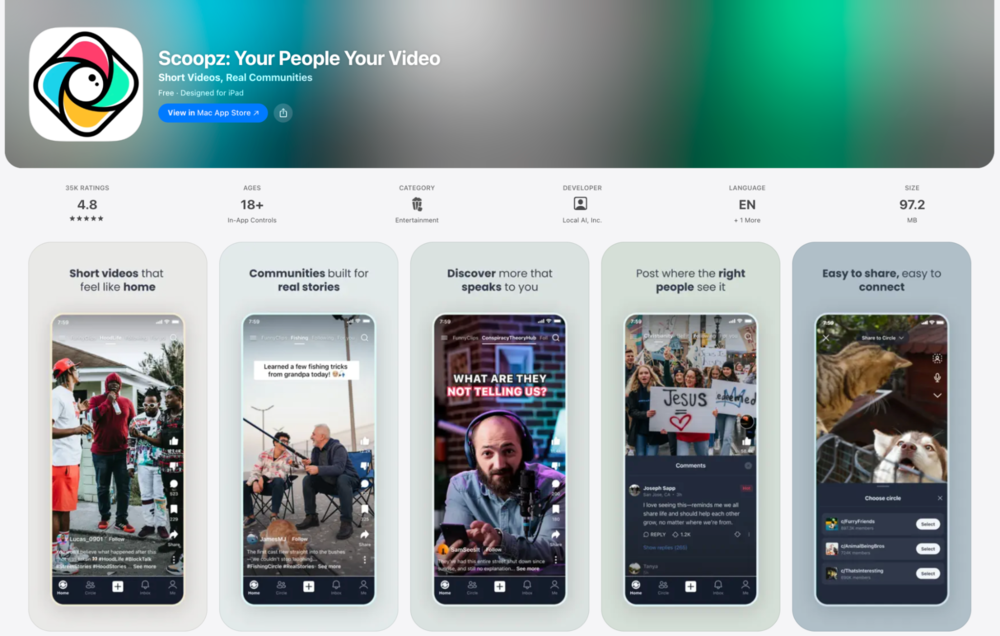
Credit: App Store
The Scoopz app is a short-form video platform often described as the so-called “TikTok 2.” Like other social media apps, users scroll through videos, post clips, leave comments, and join topic-based communities.
What makes Scoopz different is its emphasis on raw, real-life footage rather than edited entertainment. Videos may include street events, breaking incidents, or genuine everyday moments shared by users in real-time.
For some people, this feels more authentic. For kids, however, this approach creates challenges. Without strong filtering systems, children may be easily exposed to distressing or adult material while naively looking for entertainment.
The app is free to download, which makes access simple—and often fast—especially when friends encourage others to join new online circles.
What Is the Official Age Rating?
On iPhone and Android stores, Scoopz carries an 18+ age rating, as its content contains real/realistic violence, mature themes, and user-generated content.
although the platform states it is intended for older users, reports suggest age verification can be bypassed, meaning kids and teens may still gain access without difficulty.
Potential Risks of Scoopz for Kids

Credit: scoopzapk.com
Online discussions evaluating whether the Scoopz app is safe consistently raise several concerns.
1. Unpredictable Content Exposure
The lack of censorship means fewer restrictions on uploads. Children may be served content including violence, risky behaviour, or adult themes. Even searching for harmless terms can return disturbing clips. For a child expecting funny videos or harmless online dance trends, this sudden exposure can feel overwhelming.
2. Limited Moderation
Unlike mainstream platforms like TikTok and Instagram, Scoopz has been criticised for a lack of consistent moderation, allowing harmful or flagged content to remain visible for longer.
Social media algorithms are designed to maximise engagement, often prioritising sensational, divisive, or inflammatory posts.
Studies show that toxic content is contagious; reading, liking, or sharing it encourages further, similar, or more extreme, harmful content, increasing the risk of cyberbullying, harassment in comments, or harmful community dynamics.
3. Public Accounts by Default
Profiles are typically visible to all users, meaning children may unknowingly share personal information with strangers.
In real life, parents naturally supervise who their child interacts with. Online, that visibility expands instantly to thousands of people.
4. No Built-In Parental Controls
Perhaps the biggest concern for families is the absence of native parental controls. Parents cannot easily limit screen time, filter content, or monitor interactions inside the app itself.
Does Scoopz Have Safety Features?
Scoopz publishes community guidelines and reporting tools intended to remove harmful posts. However, the app has limited filtering options, no private account settings, and lacks transparency in its data handling policies.
In practice, this means safety often depends more on user behaviour than platform protection.
Why Parental Supervision Matters on Scoopz
New Africa/Shutterstock.com
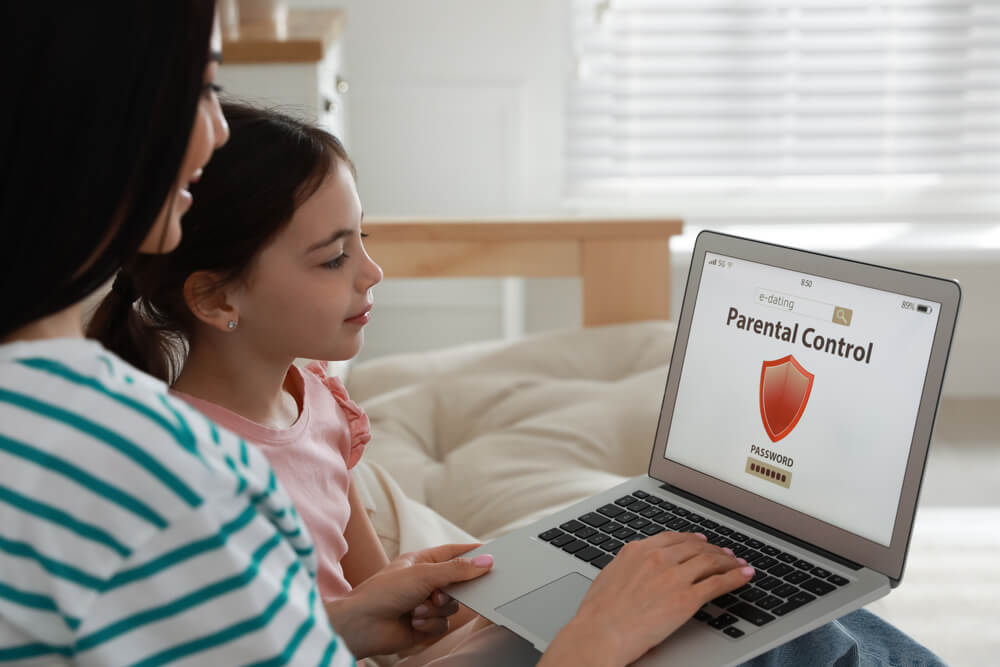
Research consistently shows that active parental mediation reduces online risk. Livingstone and Helsper (2008) found that children whose parents discuss digital behaviour openly experience fewer harmful online interactions.
Recent developmental research published in Academic Paediatrics (Child Exposure to Violent Content and Aggression: A Novel Approach to an Old Debate) followed nearly 2,000 children over time and found that greater early exposure to violent content was associated with increases in reactive aggression as children grew older, suggesting a link between media violence exposure and later aggressive behaviour.
Apps like Scoopz rely heavily on community interaction—likes, comments, and sharing—and even the child’s voice in interactions can reveal feelings or concerns, making supervision especially important.
Supervision isn’t about control; it’s about teaching digital citizenship: helping children use technology responsibly, safely, and respectfully. For parents, it’s about guiding kids to understand that their actions online have real-world consequences.
How Parents Can Reduce Risk (Practical Steps)

Kaspars Grinvalds/Shutterstock.com
If your child wants to install Scoopz—or already has—these steps can significantly improve safety.
Step 1: Start With a Conversation
Ask what your child enjoys watching and why the app appeals to them. Keeping an open mind and listening first builds trust and keeps communication open.
Step 2: Review the Download Together
Before allowing access, read the age rating and privacy information together. Teaching children to read app details builds long-term digital awareness.
Step 3: Adjust Device Settings
Since Scoopz lacks parental controls, use device-level protections:
- Restrict app downloads by age rating
- Disable location sharing
- Review notification permissions
Related: Parental Controls for Android Users; Parental Controls for iOS Users.
Step 4: Set Clear Family Expectations
agree on rules for posting videos, responding to comments, and sharing personal information. Collaborative rules are linked with safer online behaviour in children.
Step 5: Use External Safety Tools

Findmykids app
Because the Scoopz app offers limited supervision options, many families rely on complementary tools such as Findmykids. Used alongside open communication, monitoring tools support safety without undermining trust.
Findmykids allows parents to monitor overall screen time and view app usage statistics, including how much time is spent in specific apps. This visibility helps parents notice sudden shifts in digital habits that may signal stress, overuse, or online conflict.
Parents can set limits on individual apps or the entire device, either temporarily or on a recurring schedule. This makes it easier to create structured screen-free times for homework, sleep, or family activities while still allowing children to use their devices responsibly.
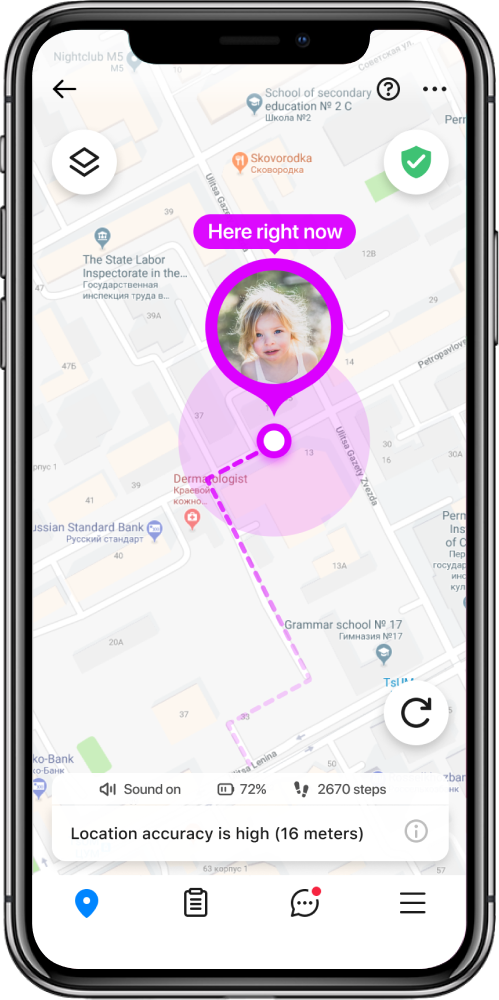
Beyond digital supervision, Findmykids also supports real-world safety through real-time location tracking and safety zone notifications, helping parents know when a child arrives at or leaves key places like school or home. In situations of genuine concern, features such as Sound Around can provide additional reassurance.
Used thoughtfully, external safety tools work best as part of a broader strategy that includes clear expectations, ongoing conversations, and consistent boundaries.
Warning Signs of Unsafe Social Media Use
Research published in the International Journal of Adolescence and Youth shows links between negative online experiences and increased emotional distress among adolescents. Watch for small behavioural changes that may signal online stress:
| Behaviour | Observable Indicators |
| Secrecy or Sudden Privacy | Your child locks their phone, hides their screen, or quickly switches apps when you walk by |
| Emotional Spikes | Anxiety, irritability, or strong reactions after reading comments or watching videos |
| Sleep Disturbances | Trouble falling asleep or waking up tired after screen time |
| Withdrawal From Offline Activities | Less interest in friends, hobbies, or family time |
| Overreaction to Minor Online Events | Getting overly upset about small likes, messages, or posts |
⠀
Keep an eye out for these early warning signs—they can help you spot stress before it escalates. Noticing small changes gives you a chance to support your child and start a calm, open conversation.
Read more: Recommended Screen Time for Kids: How Much Is Healthy by Age.
What Parents Should Understand About “Uncensored” Platforms

myboys.me/Shutterstock
Some platforms market themselves around minimal censorship, positioning openness as authenticity. But for young users, fewer restrictions often mean weaker protection systems.
Research highlights that search algorithms can return harmful or extreme content even when users start with seemingly harmless queries. For example, Ofcom’s report on search engines acting as “one-click gateways” to harmful content found that one in five search results for common self-injury terms led directly to harmful material, and even searching images or cryptic terms could return graphic or unsafe content due to algorithmic limitations.
Similarly, peer-reviewed research in JAMA Network Open shows that automated content recommendations on video platforms can surface disturbing or violent material for queries that seem child-appropriate, demonstrating that algorithmic systems are far from perfect in protecting young users.
In February, reporting on emerging digital platforms highlighted how even large social networks can fail to protect younger users when safety systems struggle to keep up with rapid growth—for example, the UK fined Reddit £14.47 million after finding it had exposed children to harmful content due to inadequate age verification and late safety safeguards.
a report by Big Tech’s Little Victims found children in the UK are potentially being exposed to harmful, sexualised and extreme content within minutes of joining social media platforms, highlighting growing concerns that rapid app growth can outpace safety development—leaving families to manage risks themselves while companies refine policies.
So, is Scoopz safe for children and teens? For most families, the answer is no—not without significant parental involvement. The platform is unsuitable for younger users.
Social media safety comes less from banning technology and more from guiding children through it. When parents stay involved, set expectations, and use supportive tools, kids learn how to navigate online spaces responsibly—whether on Scoopz or the next trending app. Awareness of algorithmic limitations, combined with research-informed guidance, helps parents protect their children while teaching them to engage online safely and responsibly.
FAQs
Is Scoopz safe for kids?
No. The Scoopz app is rated 18+ and exposes users to unfiltered content that may not be suitable for children.
Is Scoopz safe for teens (13–17)?
Most safety experts advise caution. Teens may encounter inappropriate content or contact from strangers without strong supervision.
What is the Scoopz age rating on iPhone?
The App Store lists Scoopz with an 18+ rating due to mature themes and realistic violence.
Does Scoopz have parental controls?
As of Feb 2026, Scoopz does not include built-in parental controls, meaning parents must rely on device settings or external supervision tools.
References
- Parental mediation of children’s internet use, Livingstone, S., & Helsper, E. J. Journal of Broadcasting & Electronic Media, 2008
- Scoopz Community Guidelines
- Scoopz App Safe for Kids? A Parent’s Safety Guide. Fenced.ai, 2026
- Scoopz app review: Features, safety and apps like Scoopz. FlashGet Kids, 2025
- Parental mediation and online risk, Wright, M. F., Ortega, R., & Tokunaga, R. S. Journal of Family Issues, 2018
- A systematic review: the influence of social media on depression, anxiety and psychological distress in adolescents, Keles, B., McCrae, N., & Grealish, A. International Journal of Adolescence and Youth, 2020
- Child Exposure to Violent Content and Aggression: A Novel Approach to an Old Debate, Fabricio de Andrade Rocha, Nicolas Gilbert, Carol Tabares Velasquez, Vincent Bégin, Gabrielle Garon-Carrier, Caroline Fitzpatrick. Academic Paediatrics, 2025
- Engagement, user satisfaction, and the amplification of divisive content on social media, Smitha Milli, Micah Carroll, Yike Wang, Sashrika Pandey, Sebastian Zhao, Anca D Dragan. PNAS NEXUS, 2025
- Search engines can act as one-click gateways to self-harm and suicide content. Ofcom, 2024
- Algorithmic Content Recommendations on a Video-Sharing Platform Used by Children, Jenny Radesky, Enrica Bridgewater, Shira Black, August O’Neil, Yilin Sun, Alexandria Schaller, Heidi M. Weeks, Scott W. Campbell. JAMA Network Open, 2024
- Reddit fined £14m for ‘concerning’ child age check failings, Tom Singleton and Liv McMahon, BBC News, 2026
- Robbed: How Big Tech is Stealing Childhoods, Big Tech’s Little Victims, 2026
Cover image: Freepik / Freepik.com
Проверьте электронный ящик